
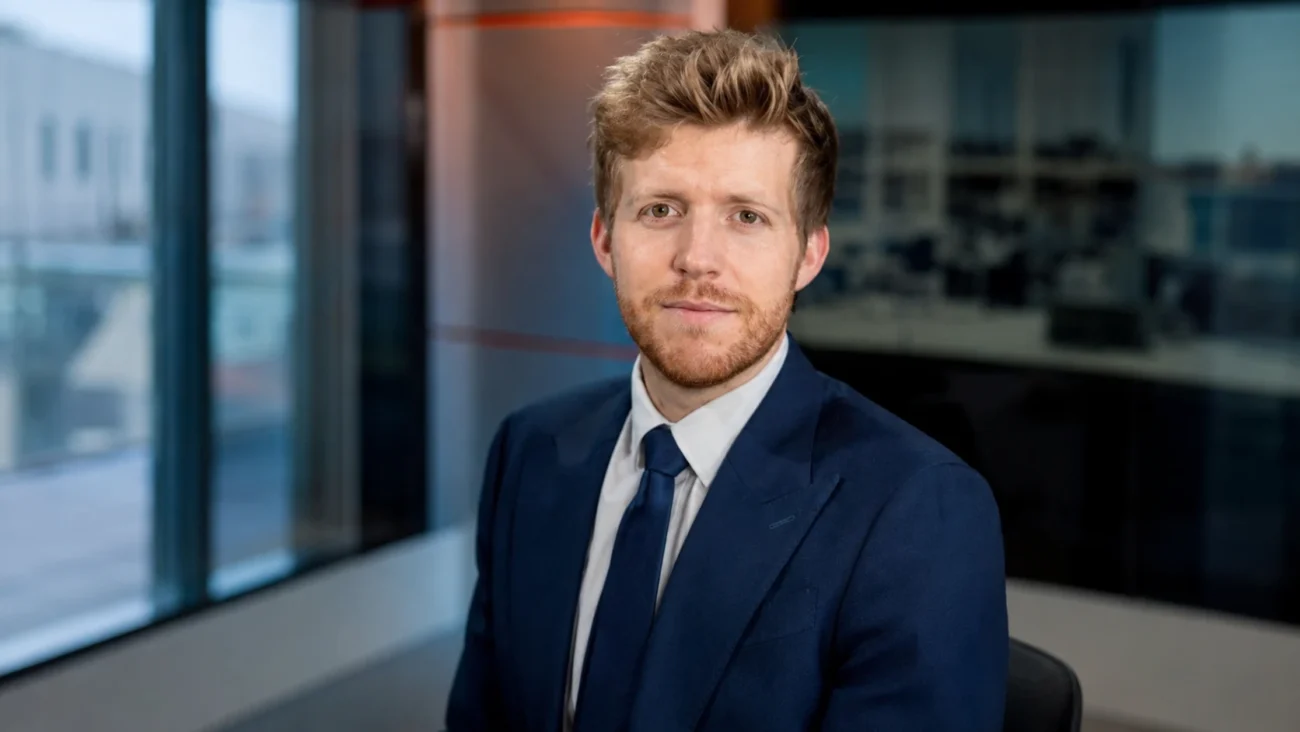
Fred Dimbleby entered British media with a surname that already carried unusual weight. For decades, the Dimbleby name has been linked to public broadcasting, election nights, political interviews and some of the most serious moments in British television history. Yet Fred’s own career is not simply an inherited story. He has built his public profile as an ITV journalist, moving through student journalism, national news production and regional political reporting at a time when British media is faster, tougher and more exposed than ever.
He is best known today as a Political Correspondent for ITV News Calendar, the regional ITV news programme covering Yorkshire and Lincolnshire. His work places him close to the practical side of politics: elections, transport promises, local government, party strategy and the way national decisions land in towns and cities outside Westminster. That makes him an interesting figure for readers who know the Dimbleby family from the BBC but are now seeing a younger Dimbleby working in a different newsroom, in a different era, with a different kind of public pressure.
Early Life and Family Background
Fred Dimbleby is the son of David Dimbleby, one of Britain’s best-known broadcasters. David became a familiar face through decades of BBC election coverage, major national broadcasts and his long tenure on Question Time. Fred’s grandfather, Richard Dimbleby, was an even earlier broadcasting giant, remembered as a pioneering BBC war correspondent and one of the defining voices of British radio and television in the 20th century.
That family background explains why Fred attracted public interest before his career had fully begun. The Dimblebys are not celebrity famous in the usual modern sense; their public identity has been built around seriousness, politics, institutions and national events. For a younger member of the family, that legacy brings recognition, but it also creates instant comparison with men whose careers unfolded over many decades.
Fred’s uncle, Jonathan Dimbleby, also became a major broadcaster and presenter, adding another branch to the family’s media history. Together, Richard, David and Jonathan shaped the public image of the family as one closely tied to current affairs and political broadcasting. Fred’s emergence as a journalist therefore felt natural to many observers, though his own path has taken him through ITV rather than the BBC world most associated with his relatives.
Education and Early Ambitions
Fred Dimbleby attended Brighton College, where he was reported to have achieved A* grades in government and politics, religious studies and history. In 2016, he was publicly reported to be heading to Oxford University to study history at Keble College. Those subjects offered an early clue to his interests: politics, public argument, belief, institutions and the long sweep of historical change.
Before university, Fred had already shown an interest in broadcasting and public debate. He chaired a Question Time-style debate at Brighton College during the European Union referendum campaign, an experience that connected him directly to the sort of political discussion his family had long been associated with. Around the same period, he also made an early radio appearance on BBC Sussex, presenting part of the breakfast programme from Brighton.
It would be too simple to say his career was decided then. Early media moments can be exploratory rather than defining, especially for a teenager with a famous surname and strong academic results. Still, the pattern is hard to miss: Fred was drawn early to history, politics, questioning and public communication, all of which later became central to his professional life.
Oxford, Cherwell and Student Journalism
At Oxford, Fred Dimbleby studied history and became involved in student journalism. He wrote for Cherwell, one of Oxford’s best-known student newspapers, and later served as one of its editors. Student journalism can look small from the outside, but in British media it has often been a training ground for future reporters, editors, columnists and political writers.
His Cherwell work covered subjects that mattered inside and beyond the university. He was associated with reporting on access, admissions and university politics, including stories about the backgrounds of students admitted to Oxford. These were not lightweight campus items; they touched on class, race, privilege and the social makeup of one of the country’s most powerful institutions.
Fred also wrote about free speech and the politics of controversial speakers. In 2018, he published an opinion piece in The Guardian about the Oxford Union’s invitation to Steve Bannon, the former adviser to Donald Trump. The article placed him in the middle of a wider student and national debate about whether high-profile controversial figures should be hosted by elite debating societies.
That period helped establish his early public voice. He was not just a student with a famous last name, but a young journalist engaging with the arguments of his generation. The tone of that work showed interest in power, performance, responsibility and the way institutions present themselves to the world.
Starting Out in Professional News
Fred Dimbleby’s professional career developed through ITV News, where he worked in national news production before moving into more visible reporting roles. ITV has identified him as having worked on its national news team in London and in its Washington DC bureau. That background suggests a grounding not only in on-screen reporting but also in the less visible newsroom work that shapes television journalism.
Production experience matters because it teaches how news is built under pressure. Producers research stories, prepare scripts, check facts, coordinate footage, brief correspondents and help turn scattered information into clear broadcast segments. For a young journalist, that kind of work can be as valuable as early screen time because it develops judgment and discipline.
His time connected to Washington also placed him near American politics and international news at a moment when global stories moved quickly across digital platforms. British broadcasters now expect journalists to understand how stories travel online as well as how they work on television. Fred’s later career reflects that mixture of video, digital reporting, interviews and explainers.
ITV News Calendar and Political Reporting
Fred Dimbleby is now best known for his work with ITV News Calendar, where he serves as a Political Correspondent. The Calendar region covers Yorkshire and Lincolnshire, an area with deep political variety and strong local identities. Reporting there means looking beyond the Westminster chamber and asking how national policy affects real communities.
His work has covered local elections, Reform UK, Labour’s regional challenges, Northern Powerhouse Rail, RAF Scampton, assisted dying, business rates and student loans. These are not abstract issues for viewers. They shape transport, public services, housing, employment, local pride and the future of towns that often feel distant from central government.
Regional political reporting requires a particular skill. A correspondent must understand national party strategy, but also know why a rail line, airbase, council tax decision or mayoral contest matters locally. Fred’s role puts him in that space between political promise and practical consequence, where voters often judge parties more sharply than they do in campaign speeches.
Covering Parties, Elections and Public Pressure
One visible part of Fred Dimbleby’s work has been reporting on party politics in Yorkshire and Lincolnshire. He has covered Labour MPs preparing for difficult local election results and Reform UK seeking support in northern England. Those stories matter because the region has become a testing ground for political loyalty, voter frustration and changing party identities.
His reporting on Nigel Farage and Reform UK has shown the tensions surrounding the party’s rise. Public rallies can reveal enthusiasm, anger and distrust all at once, and a regional correspondent has to capture more than the headline noise. The job is to show who is turning up, what they want, what critics fear and how the claims being made compare with local facts.
Transport has also been an important subject in his work. Northern Powerhouse Rail is one of those promises that sounds simple until the details appear: which cities benefit, which towns are left out, how much money is actually committed and when anything will be built. In that kind of story, Fred’s reporting has focused on the gap between political language and what people in the region can expect.
The Weight of the Dimbleby Name
The Dimbleby family legacy is impossible to ignore, but it should not flatten Fred’s own story. Richard Dimbleby reported from some of the darkest places of the Second World War and became a trusted national voice. David Dimbleby became associated with election nights, national ceremonies and public debate, while Jonathan Dimbleby built a major career in current affairs and radio.
Fred belongs to a different media age. His grandfather and father worked in eras when national broadcasts could gather enormous shared audiences. Fred works in a time of clips, online articles, regional video, social media criticism and constant political reaction.
That shift changes what authority looks like. Earlier broadcasters often became familiar through long-form programmes and national moments; younger journalists are judged through shorter appearances, live updates and shareable segments. Fred’s challenge is not to repeat the old Dimbleby model, but to find credibility in a more fragmented and less forgiving media culture.
Public Scrutiny and the Corbyn Doorstep Episode
Fred Dimbleby has also experienced public scrutiny beyond ordinary reporting. In 2020, he was identified in media reports as the ITV journalist who questioned former Labour leader Jeremy Corbyn outside his Islington home about claims of Russian interference in the 2019 general election. The exchange drew criticism online, and the reaction showed how quickly a reporter can become part of the story.
The episode was controversial because it touched several sensitive issues at once. Doorstep journalism can be seen by supporters as necessary pressure on public figures and by critics as intrusive or politically loaded. In this case, the question, the setting and the subject’s identity all contributed to a sharp online backlash.
What the episode shows most clearly is the risk faced by young political journalists in the social media age. A brief encounter can be filmed, clipped, interpreted and attacked by thousands of people who may know little about the full reporting context. For Fred, it was an early lesson in how public-facing journalism can expose the journalist as much as the politician.
Charity Work and the Richard Dimbleby Cancer Fund
Away from daily reporting, Fred Dimbleby has been connected to the Richard Dimbleby Cancer Fund. The charity, founded in memory of his grandfather, supports people affected by cancer and has been associated with improving access to cancer care information. Fred has served as a trustee, continuing a family link that reaches beyond broadcasting.
His involvement reflects another side of the Dimbleby legacy. Richard Dimbleby’s death from cancer in 1965 had a strong public impact, and the fund created in his name became part of the family’s ongoing contribution to public life. Fred’s trustee role connects his digital media experience with the charity’s work in helping people find support and information.
That detail is meaningful because it shows a less visible form of public service. Journalism is one route through which the family has informed audiences; cancer support is another route through which it has tried to help people facing uncertainty. Fred’s place in that work sits alongside his newsroom career rather than apart from it.
Personal Life, Marriage and Family Privacy
Fred Dimbleby’s family background is public, but his own private life is not widely documented. There is no strong public record confirming details such as a spouse, marriage, children or long-term partner. For that reason, any biography should avoid presenting private claims as fact.
This is an important distinction because public curiosity often moves faster than verified information. Being the son of a famous broadcaster does not make every part of Fred’s personal life a matter of public record. His public identity is built mainly around his work as a journalist, his education, his family background and his charity role.
Respecting that boundary is not the same as leaving out important facts. It simply means treating him as a professional figure rather than a celebrity whose private relationships are central to the story. Unless he chooses to share more, the responsible approach is to focus on the confirmed record.
Net Worth, Income and Career Standing
There is no credible public estimate of Fred Dimbleby’s net worth. Some websites may guess figures for media personalities, but guesses are not reliable biography material. Fred’s known income source is his journalism work, particularly his role with ITV News, though ITV does not publicly disclose his salary.
His career standing is better understood through his assignments than through money. He has moved from student journalism to national news production and then to a named political correspondent role in a major ITV region. That is a serious professional path, especially for someone still relatively early in his career.
The Dimbleby name may attract attention, but it does not file a report, conduct an interview or explain a policy on deadline. In television news, credibility is built through repeated work under pressure. Fred’s public standing now rests on that work more than on any public estimate of wealth.
Public Image and Media Identity
Fred Dimbleby’s public image is shaped by contrast. He is connected to one of the most established names in British broadcasting, yet he works in a modern news environment where authority is less automatic. Viewers who know his surname may arrive with expectations, but they encounter him through regional reports, political interviews and online explainers.
His media identity is also quieter than many modern public figures. He does not appear to have built a career around self-promotion or personal branding. Instead, his profile comes through the institutions he has worked with: Oxford student journalism, The Guardian, ITV News and the Richard Dimbleby Cancer Fund.
That restraint may be partly professional. Political correspondents often need to maintain a degree of distance, because the work depends on being taken seriously by viewers across party lines. For someone with a famous surname, understatement can also help keep the focus on the reporting rather than the family mythology.
Where Fred Dimbleby Is Now
Fred Dimbleby is currently working as a political journalist for ITV News Calendar. His role places him in a region that is likely to remain politically important, especially as voters continue to test Labour, the Conservatives, Reform UK, the Liberal Democrats and the Greens in local and national contests. Yorkshire and Lincolnshire offer exactly the kind of political ground where national stories become concrete.
His recent work shows a journalist covering both policy and political mood. Local election warnings, transport plans, party rallies and public-service debates all require a mix of context and clear explanation. Those stories may not always carry the glamour of Westminster set pieces, but they often matter more directly to viewers’ lives.
The next stage of Fred Dimbleby’s career will likely depend on how he continues to balance inheritance and independence. The surname will always open curiosity, and perhaps scrutiny too. But the record he is building belongs to him: a working reporter covering politics in a demanding regional beat.
Frequently Asked Questions
Who is Fred Dimbleby?
Fred Dimbleby is a British journalist best known for his work with ITV News. He is a Political Correspondent for ITV News Calendar, covering politics and public affairs across Yorkshire and Lincolnshire. He is also known as the son of broadcaster David Dimbleby and the grandson of Richard Dimbleby.
Is Fred Dimbleby related to David Dimbleby?
Yes, Fred Dimbleby is David Dimbleby’s son. David Dimbleby is one of Britain’s most recognised broadcasters, especially known for BBC election coverage and Question Time. Fred is also the grandson of Richard Dimbleby and the nephew of Jonathan Dimbleby.
What did Fred Dimbleby study?
Fred Dimbleby studied history at Keble College, Oxford. Before Oxford, he attended Brighton College and was reported to have achieved top A-level results in government and politics, religious studies and history. His academic interests closely matched the political and historical themes that later appeared in his journalism.
What is Fred Dimbleby’s job now?
Fred Dimbleby works as a Political Correspondent for ITV News Calendar. His reporting focuses on political developments in Yorkshire and Lincolnshire, including local elections, transport policy, party politics and regional public affairs. He has also worked in ITV’s national news operation and its Washington DC bureau.
Is Fred Dimbleby married?
There is no widely verified public information confirming that Fred Dimbleby is married. His private relationships are not a major part of the public record. Most reliable information about him focuses on his education, journalism career, family background and charity work.
What is Fred Dimbleby’s net worth?
Fred Dimbleby’s net worth has not been credibly reported by authoritative sources. His known professional income comes from journalism, especially his work with ITV News. Any exact figure online should be treated as an estimate unless it comes from a reliable financial or public-record source.
Why is Fred Dimbleby famous?
Fred Dimbleby is known partly because he comes from the Dimbleby broadcasting family, one of the most respected names in British media. He is also building his own career as an ITV journalist and political correspondent. His public profile combines family legacy with his own work in modern political reporting.
Conclusion
Fred Dimbleby’s biography is still being written in real time. He is not a retired broadcaster looking back on a finished career, but a working journalist building one under public attention. That makes his story less about final verdicts and more about direction, discipline and the pressures of a famous name.
What stands out is the continuity of interest across generations. The Dimbleby family has long been associated with politics, public life and serious broadcasting. Fred has entered that world through a different door, working in ITV’s digital and regional news environment rather than simply repeating the BBC careers of his father, uncle and grandfather.
His strongest claim to attention now is the work itself. He covers the politics that affect communities outside London, where promises about rail, migration, councils and elections turn into real consequences. That is a demanding beat, and it gives him room to become known for more than his surname.
For readers searching Fred Dimbleby today, the clearest answer is this: he is a young British journalist with a famous broadcasting inheritance, but his public identity is increasingly his own. The next chapter will depend not on the family name he carries, but on the reporting he continues to do.
