
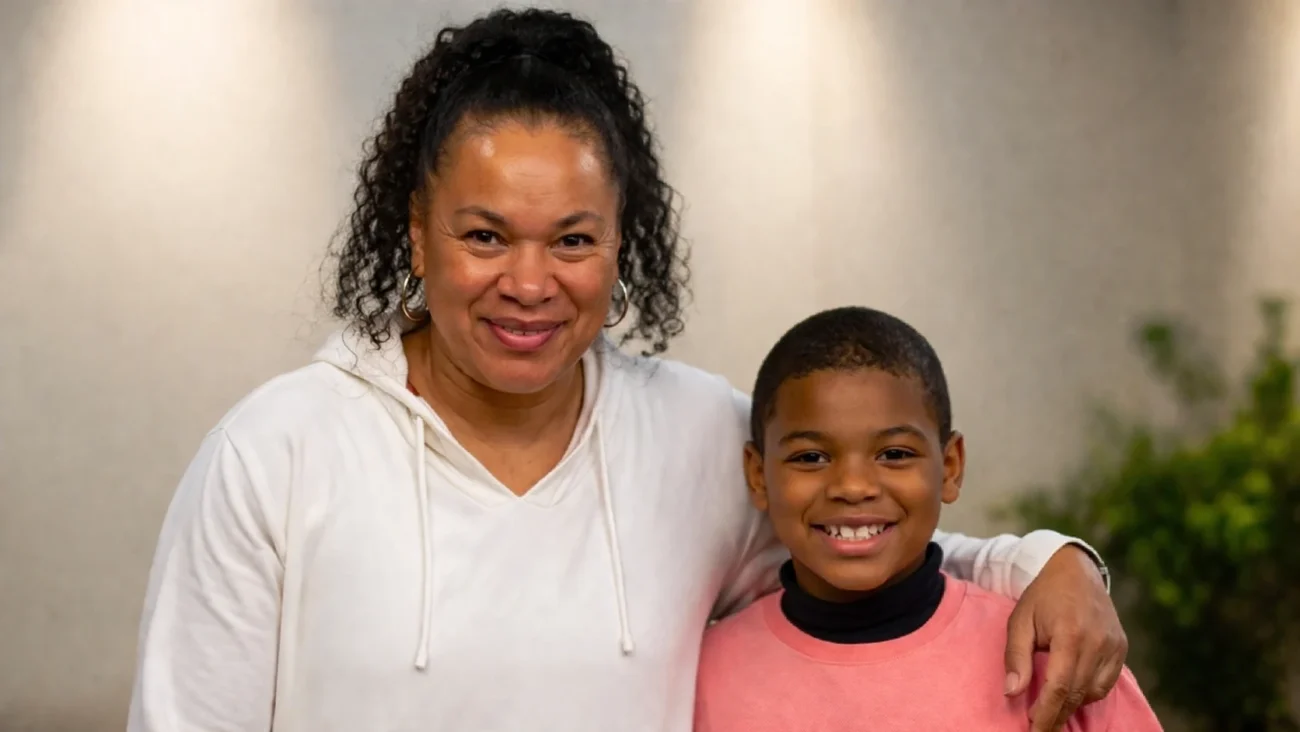
On a spring afternoon in Columbia, South Carolina, Dawn Staley stood before a crowd gathered for a statue unveiling in her honor. The bronze figure captured her mid-celebration, cutting down a championship net, a moment frozen in time that symbolized decades of influence on the court. Yet, as fans and media flocked to photograph the scene, one question quietly persisted online: does Dawn Staley have a son? It’s a query that has circulated widely, fueled by her maternal approach to coaching and her reputation as a mentor. The answer, based on every credible source available, is that she does not have a publicly confirmed child. Understanding why this question arises requires looking at Staley’s family, her career, and the way she interacts with the young women she leads.
Early Life and Family
Dawn Michelle Staley was born on May 4, 1970, in Philadelphia, Pennsylvania, into a large and tightly knit family. Her parents, Clarence and Estelle Staley, had moved from Orangeburg County, South Carolina, in the 1950s and settled in North Philadelphia’s Raymond Rosen Homes. They raised five children: Lawrence, Anthony, Tracey, Eric, and Dawn. Estelle was a homemaker, while Clarence worked as a part-time carpenter, and together they instilled discipline, faith, and a strong work ethic in their children. Staley often reflects on her childhood with a sense of gratitude and responsibility, crediting her mother with shaping her character and determination. Her upbringing, marked by structure and accountability, laid the foundation for the leadership style she would later bring to her teams. (People)
The Staley household was strict but nurturing. Dawn has described her mother as a disciplinarian whose faith guided her approach to raising children. The family environment emphasized respect, hard work, and community, values that Staley carried into her athletic and coaching career. She remains the youngest in her family and has spoken openly about the influence her siblings had on her, particularly in fostering competitiveness and resilience. Her personal narrative has consistently highlighted these early family lessons rather than focusing on private adult relationships or children of her own.
Education and Early Ambitions
Staley attended Murrell Dobbins Vocational Technical High School in North Philadelphia, where she led the basketball team, the Mustangs, to three public league championships. By the time she graduated in 1988, she had earned national recognition as USA Today’s High School Player of the Year, an accolade that set her on a trajectory toward collegiate stardom. Her talent and dedication earned her a scholarship to the University of Virginia, where she would become a two-time Naismith College Player of the Year and lead the Cavaliers to three Final Fours. During these years, her focus was entirely on basketball, academics, and developing the skills that would carry her into the professional ranks. (Wikipedia)
At Virginia, Staley honed her skills as a point guard, earning accolades that included two Honda Sports Awards and repeated All-American honors. Her early ambitions were less about personal life and more about achieving excellence on the court, which she did with remarkable consistency. By the time she graduated in 1992, she had firmly established herself as one of the premier players in women’s college basketball.
Professional Playing Career
Following her college career, Staley played professionally in both the American Basketball League (ABL) and the WNBA, as well as overseas. She joined the Charlotte Sting as the ninth overall pick in the 1999 WNBA draft and later played for the Houston Comets. Over her playing career, she was a six-time WNBA All-Star and earned multiple awards recognizing her contributions to the sport. Staley also won three Olympic gold medals with Team USA in 1996, 2000, and 2004, serving as the U.S. flag bearer in Athens in 2004. These achievements not only cemented her legacy as an elite athlete but also provided a platform for future leadership roles in basketball. (Britannica)
Her professional years were defined by skill, leadership, and visibility rather than domestic life. There is no record from this period indicating marriage or children. The public’s interest in her personal life intensified only after she became a highly visible coach and community figure.
Coaching Career and Mentorship
Staley began her coaching career at Temple University in 2000, where she led the Owls to multiple NCAA tournament appearances over eight seasons. In 2008, she accepted the head coaching position at the University of South Carolina, transforming a middling program into a national powerhouse. Under her leadership, the Gamecocks have won three NCAA championships, reached six Final Fours, and maintained top-tier national rankings. Staley’s coaching style is disciplined, strategic, and deeply invested in the personal development of her players. (Gamecocksonline)
It is during her coaching career that the “son” question often arises. Staley frequently refers to her players as her “kids,” a term that signifies the deep mentorship and protective role she assumes. In The Players’ Tribune, she wrote about her players in the context of guidance and responsibility, likening them to children in moments of challenge or reflection. This metaphorical language, while evocative, has sometimes been misinterpreted as an indication of biological parenthood. (Players’ Tribune)
Community Engagement and Youth Programs
Staley’s commitment to youth extends beyond her collegiate roster. She founded the Dawn Staley Foundation in 1996, focusing on academic and athletic programs for young people in North Philadelphia. She also co-founded INNERSOLE in 2013, a nonprofit providing new sneakers to children experiencing homelessness or economic hardship. These programs underscore her genuine investment in the next generation, amplifying her public image as a maternal figure, even in the absence of a biological child. (Owlsports)
Through these initiatives, Staley has created meaningful opportunities for children and teenagers, often filling gaps left by systemic inequities. Her foundation work, along with her coaching, demonstrates a dedication to mentorship that goes beyond sports performance, encompassing academics, life skills, and personal growth.
Personal Life and Public Record
Staley has remained private about romantic relationships and family life. Credible sources indicate she is not married and has not publicly disclosed having children. The persistent search for a “Dawn Staley son” likely reflects both her nurturing coaching style and her extensive engagement with youth, rather than undisclosed parenthood. Public profiles, biographies, and interviews consistently reference her role as a daughter, sister, aunt, coach, and mentor. (Town & Country)
The conversation around her relationship with longtime assistant coach Lisa Boyer has occasionally fueled misinterpretation. Staley once referred to Boyer as part of an “old married couple” dynamic in a social media post, a phrase meant humorously and reflecting professional rapport rather than a romantic relationship. Boyer herself is a distinguished coach, serving as associate head coach at South Carolina since 2010, and has been integral to Staley’s program success. (Yahoo Sports)
Public Recognition and Legacy
Staley’s career achievements have garnered broad recognition. She was inducted into the Naismith Memorial Basketball Hall of Fame in 2013 and is slated for induction into the FIBA Hall of Fame in 2025. In 2025, she signed a historic $25 million contract extension with South Carolina, making her the highest-paid women’s college basketball coach. In April 2025, the city of Columbia unveiled a 14-foot bronze statue honoring her contributions to sports and community, and in 2026 she was elected to the American Academy of Arts and Sciences. These milestones underscore her status as a transformative figure in basketball and public life. (Reuters; Columbia SC; University of South Carolina)
Where Dawn Staley Is Now
As of 2026, Staley continues to lead South Carolina’s women’s basketball program with an emphasis on excellence, mentorship, and community engagement. Her teams compete at the highest levels of NCAA women’s basketball, and she remains active in national and international coaching circles. Despite widespread curiosity, her personal life remains private, and there is no verified information to indicate that she has a son. Her influence is measured through her players’ achievements, her philanthropic work, and her role in shaping the sport for future generations.
Staley’s mentorship extends through players who have gone on to the WNBA, international competition, and coaching, illustrating that her impact often manifests in professional and personal success for others. She continues to be a symbol of leadership, resilience, and dedication to the growth of women’s basketball.
Frequently Asked Questions
Does Dawn Staley have a son?
No credible source confirms that Dawn Staley has a son. All public records, official biographies, and reputable media profiles list her as a daughter, sister, and mentor but do not identify children of her own.
Is Dawn Staley married?
Staley has not publicly disclosed a marriage. She maintains a private personal life, and reports regarding her relationship with assistant coach Lisa Boyer reflect professional camaraderie, not marriage.
Why do people search for “Dawn Staley son”?
Search interest is largely fueled by her use of familial language for players, her mentorship of youth, and occasional online misinterpretation of her private life. Some confusion may also arise from the Staley surname being shared with Duce Staley and his son, Damani.
Who are Dawn Staley’s parents and siblings?
Her parents were Clarence and Estelle Staley, who raised five children in North Philadelphia. Dawn’s siblings are Lawrence, Anthony, Tracey, and Eric.
What is her legacy outside of family?
Staley is celebrated for her coaching achievements, including NCAA championships, Olympic gold medals as player and coach, her community work with foundations like INNERSOLE, and her broader influence on women’s basketball culture.
How does she describe her players?
She often refers to them as her “kids” to convey mentorship, care, and guidance. This is metaphorical language reflecting her coaching philosophy rather than evidence of parenthood.
Conclusion
Dawn Staley’s story is not defined by private family details but by public accomplishments and influence. She has shaped the lives of countless athletes, led teams to national prominence, and used her platform to expand opportunities for children and youth. While curiosity about a son persists, the verified record shows her impact through mentorship, leadership, and service rather than biological parenthood.
Her legacy combines championship excellence with community engagement, and it continues to grow as she guides new generations of athletes. The truth about Dawn Staley is found in her leadership, the programs she has built, and the lives she has touched. The question of a son is answered clearly: no public evidence supports it, and her story remains remarkable without it.
