
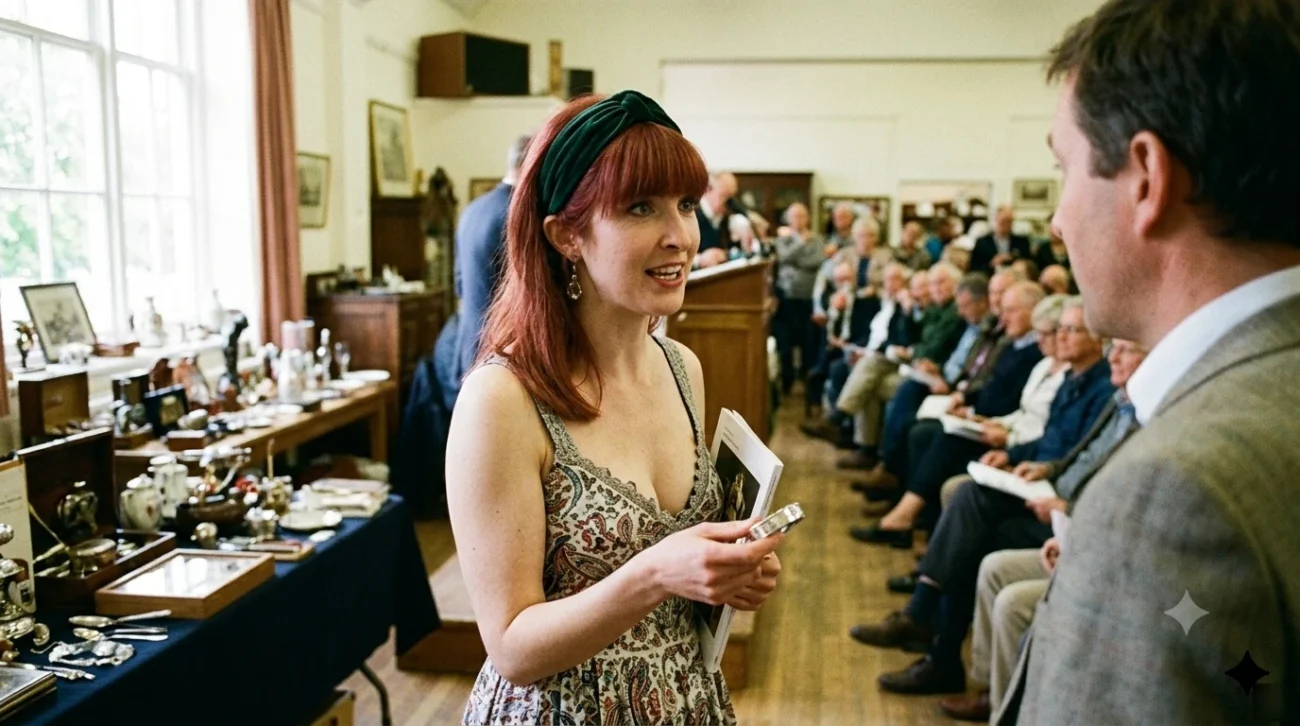
Izzie Balmer became familiar to British television viewers through a kind of work that looks gentle on screen but depends on nerve, knowledge, and timing. On programmes such as Antiques Road Trip, Bargain Hunt, Flog It! and The Travelling Auctioneers, she appears as a calm, bright presence who can turn a brooch, a silver pot, or a dusty box from a house clearance into a story about craft, fashion, family, and value. Her appeal is not built on celebrity excess or confessional drama. It comes from watching someone who knows her subject explain it without making the viewer feel shut out.
That is why the interest in Izzie Balmer is broader than a passing curiosity about a television expert. Viewers want to know who she is, where she came from, whether she is a real auction specialist, and what her life looks like away from the auction room. The honest answer starts with the work: Balmer is a British auctioneer, valuer, jewellery specialist, and presenter whose public profile grew from practical auction-house experience. She has become one of the more recognisable younger experts in a television field often shaped by long memory, specialist vocabulary, and the thrill of a surprise hammer price.
Early Life and Family Background
Izzie Balmer is from Derby, England, and has spoken publicly about returning home after university during a period when she was unsure what she wanted to do next. Her family background has not been heavily documented in the way that an actor’s or politician’s might be, and she has kept many personal details outside the public record. That privacy is part of how she has managed her career: the professional facts are visible, while the domestic story remains largely her own. For a profile of Balmer, that distinction matters because it keeps the focus on what is known rather than what online biography pages try to guess.
What is clear is that her early path was not a neatly planned route into antiques television. She studied geography at university, a choice that does not obviously point toward jewellery valuation or auctioneering. After graduating, she considered more conventional graduate paths but did not settle immediately into one. That uncertainty became important because it eventually pushed her toward work that mixed research, objects, people, and performance.
Balmer has described working in a vintage shop as one of the steps that brought old objects into sharper focus for her. That kind of environment can teach a young specialist things that are hard to learn from a textbook alone. You see how people respond to age, condition, design, wear, and memory. You also begin to notice that value is not only about what something cost when new, but about what later buyers believe it means.
Education and First Ambitions
Balmer’s university education in geography may seem far removed from the antiques trade, but it helps explain one part of her professional style. Geography teaches observation, place, material culture, and the relationship between people and their environments. An auction specialist also has to read clues in objects, place them in context, and explain why they matter. The subject did not train her as a gemmologist, but it did not leave her without useful habits either.
Her earliest ambitions were not publicly framed around becoming a television personality. In interviews, she has described a less polished process of trying things, rejecting some expected graduate options, and finding direction through work experience. That is a more believable career story than the myth of someone always knowing exactly who they would become. Balmer’s route had trial, uncertainty, and a willingness to start at the practical end of the business.
The decisive shift came when she gained experience at a local auction house. Her early tasks included packing and posting items, work that may sound ordinary but sits close to the heart of the trade. Packing an object forces you to handle it, measure it, inspect it, and think about its fragility. Over time, that contact builds the sort of eye that auction specialists rely on every day.
Learning the Auction Trade from the Ground Up
Auction houses are not romantic workplaces all the time. They are busy, deadline-driven businesses filled with cataloguing, condition reports, client questions, estimates, reserves, transport, photography, and sale-day pressure. Balmer’s early auction work exposed her to the machinery behind the public moment of the hammer falling. That practical grounding matters because it separates a working valuer from someone who merely enjoys old things.
She moved from packing and handling objects into work that brought her closer to cataloguing and valuation. That step required research, confidence, and the ability to make careful judgments with incomplete information. In the auction world, mistakes are not just embarrassing; they can affect clients, buyers, and the reputation of a saleroom. A specialist has to learn when to trust an instinct and when to check again.
Balmer later became associated with Wessex Auction Rooms in Wiltshire, where she worked as a valuer and developed her specialism in jewellery and silver. By the time she was being profiled by antiques publications, she was described as a head valuer and a specialist in those areas. That is a serious professional identity, not simply a television label. It means she had earned trust in a trade where knowledge is tested in public by the market.
Gemmology, Diamonds, Jewellery, and Silver
Balmer’s strongest public specialism is jewellery, supported by formal training in gemmology and diamonds through the Gemmological Association of Great Britain. She has been listed professionally with FGA and DGA credentials, which refer to gemmology and diamond qualifications. Those letters matter because jewellery valuation is a technical field, not just an exercise in taste. A valuer has to understand stones, settings, condition, metal, workmanship, fashion, and market appetite.
Jewellery also carries emotional weight in a way that many auction categories do not. A ring may have been worn for decades, a brooch may have passed through generations, and a box of inherited pieces may represent a family’s unspoken history. A valuer has to respect that feeling while still giving a realistic market view. Balmer’s television work often depends on exactly that balance: warmth without false reassurance.
Her work with silver adds another layer of expertise. Silver valuation can involve hallmarks, makers, date letters, assay offices, weight, condition, engraving, and design taste. The market can shift depending on whether an object is valued as metal, craft, decorative design, or historical evidence. Balmer’s ability to speak about both jewellery and silver gives her a useful range on screen and in the saleroom.
Career Breakthrough on Television
Balmer’s move into television came through her auction work rather than a separate entertainment career. She appeared on BBC antiques formats including Street Auction, Bargain Hunt, and Flog It! before becoming better known to a wider audience through Antiques Road Trip. These programmes depend on experts who can do more than identify objects. They need people who can explain risk, value, history, and taste in a few clear sentences.
Antiques Road Trip gave Balmer a broader platform because the format suits her skill set. Experts travel, buy items, make judgments under budget pressure, and send their choices to auction. The show turns professional habits into a friendly contest, but the results are real enough to create tension. A good buy can look ordinary at first, while a confident purchase can disappoint once bidders have their say.
Her early success on the programme helped establish her as more than a guest expert. Viewers responded to her directness, her specialist eye, and her natural screen presence. She did not need to perform eccentricity to stand out. The combination of technical knowledge and approachable explanation made her a strong fit for daytime antiques television.
Antiques Road Trip and Public Recognition
Antiques Road Trip has long worked because it makes the antiques trade feel accessible without removing the uncertainty that makes it exciting. The viewer follows the expert from shop to shop, sees the negotiation, learns the backstory, and then waits for the auction result. Balmer’s presence in that format is effective because she can make a small object feel worth considering. She pays attention to detail, but she does not bury the audience in trade language.
The programme also helped introduce Balmer to viewers beyond people who follow auction houses closely. In British daytime television, familiarity builds slowly through repeated appearances and trusted judgment. Balmer became one of those experts people recognised not because of scandal or self-promotion, but because she kept turning up with useful explanations. That steady visibility is the kind of fame that fits the antiques genre.
Her work on the show also reflects a wider change in the trade. Antiques television is no longer only about grand furniture, formal collecting, and older connoisseurs. It now covers vintage design, small decorative objects, jewellery, salvage, and affordable finds. Balmer’s age, style, and specialist background help make that world feel open to newer audiences.
The Travelling Auctioneers and a Broader Role
Balmer’s role on The Travelling Auctioneers expanded her television identity beyond the buying-trip contest format. The programme pairs auction expertise with restoration and visits people who have objects to sell, often for personal or practical reasons. That setting changes the emotional texture of the work. Instead of only trying to make a profit from a purchase, the expert is helping owners understand what they have and what it might become.
This is where Balmer’s manner matters. A home visit or valuation can involve grief, downsizing, inheritance, financial need, or the simple difficulty of letting go. The expert has to be honest about value while showing care for the person attached to the object. Balmer’s calm, friendly style suits that job because she can keep the process clear without making it feel cold.
The programme also shows why television auctioneering is not only about objects. It is about trust. Viewers need to believe that the expert knows the market, respects the owner, and can explain the result if an item sells below expectations. Balmer’s continued involvement in the format suggests that producers value her ability to carry all three parts of that role.
Freelance Work and Current Professional Life
In recent years, Balmer has moved into a more flexible professional life that includes television, valuation work, consultancy, and specialist advisory services. She has been listed by Clevedon Salerooms as a jewellery consultant and associate valuation specialist after joining its valuation team in 2024. That current role is important because it confirms that her auction-room expertise remains active. She is not simply a former valuer who now appears on television.
Her freelance work has also been described as including probate reports, estate work, downsizing support, consultancy for auction houses, and help for retailers. Those services show how broad a modern valuer’s work can be. People do not need specialists only when they want to sell a dramatic antique on television. They need them when a parent dies, when a house is cleared, when jewellery must be insured, or when a family wants a fair division of possessions.
This stage of Balmer’s career looks like a natural extension of her earlier training. She has the television profile to reach a broad public, but she also has the trade background to work with clients away from cameras. That mix gives her professional independence. It also places her in a group of modern antiques experts whose authority comes from both specialist knowledge and public communication.
Public Image and Why Viewers Like Her
Balmer’s public image is unusually steady. She is known for being knowledgeable, warm, and practical rather than flamboyant. In a genre where some presenters lean into character, she tends to let the objects do much of the work. That restraint helps her credibility because the viewer senses that the valuation comes first.
Part of her appeal is generational. The antiques world can sometimes seem intimidating to people who did not grow up around salerooms, inherited furniture, or collecting culture. Balmer helps soften that barrier without making the subject shallow. She represents a younger expert who takes the trade seriously but does not make it feel closed.
Her style also works because she explains uncertainty honestly. Auctions are unpredictable, and even experienced specialists can be surprised by what bidders decide on the day. Balmer’s work shows that valuation is not magic and not guesswork either. It is an informed judgment that still has to face the market.
Relationships, Marriage, and Private Life
Balmer has kept her private life largely out of the public record. There is no reliable, widely confirmed public information establishing that she is married, has a husband, or has children. Many low-quality online biography pages make claims about television personalities’ relationships, but those claims often appear without sourcing. In Balmer’s case, the responsible approach is to say clearly that her confirmed public profile is professional rather than domestic.
That privacy should not be treated as a mystery that needs solving. Some public figures build their image around family access, but Balmer has not done that. Her interviews and professional profiles focus on work, training, freelancing, television, and the auction trade. That boundary is reasonable, especially for someone whose fame comes from specialist expertise rather than personal exposure.
Readers may still search for those details because television creates a sense of familiarity. Seeing someone regularly in your home through a screen can make them feel known, even when they have shared very little private information. But here’s the thing: familiarity is not the same as public record. A respectful biography should not invent intimacy where the person has chosen not to provide it.
Net Worth, Income Sources, and Money
There is no verified public figure for Izzie Balmer’s net worth. Several celebrity-style websites may offer estimates, but those numbers should be treated with caution because they rarely explain contracts, business income, taxes, expenses, assets, or liabilities. A credible biography cannot turn an unsourced estimate into fact. The most accurate statement is that her net worth is not publicly confirmed.
Her income sources are easier to describe in general terms. Balmer likely earns through television work, valuation services, consultancy, auction-related projects, and specialist jewellery or silver advisory work. Freelance experts often have mixed income streams rather than a single salary. The value of that work can vary depending on filming schedules, private commissions, valuation reports, saleroom arrangements, and consultancy demand.
Money is still relevant because it helps explain the business side of her career. Balmer has built a professional identity that can operate inside and outside television. That gives her more control than a traditional single-employer path might provide. It also means public estimates of her wealth are likely to miss the real complexity of how her work is structured.
Setbacks, Turning Points, and Professional Pressure
Balmer’s public story does not include a major scandal or widely reported controversy. The more meaningful turning points are quieter: the uncertainty after university, the move from casual vintage interest into auction work, the decision to train formally in gemmology, and the later shift into freelancing. Those are not tabloid moments, but they are the choices that shaped her career. They show a person building authority step by step.
Auction work carries its own pressures even when it does not produce public drama. A valuer must tell people things they may not want to hear, including that a treasured object is worth less than expected. They must also spot quality, damage, repairs, imitation, and market shifts. On television, that pressure is condensed into a few minutes, but the professional judgment behind it is real.
Freelancing brings another kind of pressure. It requires self-direction, reputation management, client trust, and the ability to move between different kinds of work. Balmer’s recent career suggests that she has chosen variety over the security of one narrow role. That choice can be demanding, but it also seems to fit the range she has developed.
Cultural Influence and Industry Standing
Izzie Balmer’s influence is not the kind measured by awards ceremonies or box-office records. It is quieter and more specific. She helps make the antiques trade legible to viewers who may own inherited jewellery, browse vintage shops, or wonder whether an old object has more history than they realised. In that sense, her work has a practical cultural effect.
She also broadens the image of who an antiques expert can be. The field has long been shaped by experienced dealers, senior auctioneers, and collectors with decades of specialist knowledge. Balmer belongs to a younger generation that combines formal training, saleroom experience, television communication, and freelance adaptability. That matters because the survival of the antiques trade depends partly on whether new audiences find it welcoming.
Her standing comes from consistency rather than noise. She has worked across respected BBC formats, held specialist saleroom roles, and maintained a professional identity in jewellery and silver. That may sound less dramatic than celebrity reinvention, but it is the kind of record that matters in her field. Trust is built through repeated, competent work.
Where Izzie Balmer Is Now
Izzie Balmer is currently best understood as a television antiques expert and working freelance valuer with a specialism in jewellery and silver. Her professional life includes BBC antiques programming and valuation-related work, including consultancy and client services. She has been connected with Clevedon Salerooms as a jewellery consultant and associate valuation specialist. That combination places her firmly in both the public and professional sides of the antiques world.
Her continuing involvement in Antiques Road Trip and The Travelling Auctioneers keeps her visible to viewers who follow BBC antiques television. These formats remain popular because they turn everyday objects into stories with stakes. Balmer’s role is to bring expertise to that process without making it feel remote. She understands that viewers want both information and the pleasure of discovery.
Away from television, her work appears to be moving in the direction many modern specialists now take. She is not limited to one auction podium or one kind of valuation. Her career includes media, private client work, saleroom consultancy, and practical support around estates and downsizing. That range may be the clearest sign of where her professional future lies.
Frequently Asked Questions
Who is Izzie Balmer?
Izzie Balmer is a British auctioneer, valuer, jewellery specialist, and television presenter. She is best known for appearing on BBC antiques programmes including Antiques Road Trip, Bargain Hunt, Flog It! and The Travelling Auctioneers. Her professional background is in auction-house valuation, with a special focus on jewellery and silver.
Where is Izzie Balmer from?
Izzie Balmer is from Derby, England. She has spoken about returning home after university before finding her way into vintage and auction-related work. Her early career path was not a straight line into television, which makes her later success feel rooted in practical experience rather than sudden fame.
What qualifications does Izzie Balmer have?
Balmer has been publicly listed with FGA and DGA credentials connected to gemmology and diamond training through the Gemmological Association of Great Britain. She studied gemmology and diamonds in Birmingham, a city with a strong jewellery heritage. Those qualifications support her work as a jewellery and silver specialist.
Is Izzie Balmer married?
There is no reliable public confirmation that Izzie Balmer is married. She has kept her private life largely separate from her professional profile. Claims about her husband, partner, or children on unsourced biography sites should not be treated as confirmed facts.
What is Izzie Balmer’s net worth?
Izzie Balmer’s net worth is not publicly verified. Online estimates should be treated as estimates only, and many are not supported by clear evidence. Her likely income sources include television work, valuation services, auction consultancy, and specialist jewellery-related work.
Does Izzie Balmer still work in auctions?
Yes, public professional information indicates that she remains active in valuation and auction-related work. She has been listed as a jewellery consultant and associate valuation specialist with Clevedon Salerooms. Her work also includes freelance valuation, probate, consultancy, and estate-related services.
What TV shows is Izzie Balmer known for?
Balmer is known for Antiques Road Trip, Bargain Hunt, Flog It!, Street Auction, and The Travelling Auctioneers. Her strongest association for many viewers is with BBC antiques programming. These shows use her auction knowledge, jewellery expertise, and ability to explain value clearly.
Conclusion
Izzie Balmer’s biography is not a story of instant celebrity. It is the story of a specialist who learned the trade from the practical end, built formal expertise in jewellery and diamonds, and then became a trusted face on television. That path gives her public image a steadiness that suits the world she works in.
Her appeal lies in the way she handles objects and people with the same care. She can talk about gemstones, silver, auction estimates, and market surprises without making the viewer feel out of their depth. That skill is easy to underestimate, but it is central to why she works so well on screen.
What shaped Balmer most appears to be curiosity sharpened by experience. She started without a fixed plan, found direction through old objects, and turned specialist knowledge into a career that now spans salerooms, homes, television sets, and private clients. In a field built on history, she represents a modern kind of expert: trained, practical, camera-ready, and still closely tied to the work itself.
For readers searching her name, the most useful answer is also the simplest. Izzie Balmer is not just a presenter who talks about antiques; she is a working valuer whose television career grew from real auction-house knowledge. That is why she continues to matter in a genre where trust, clarity, and judgment are everything.
