
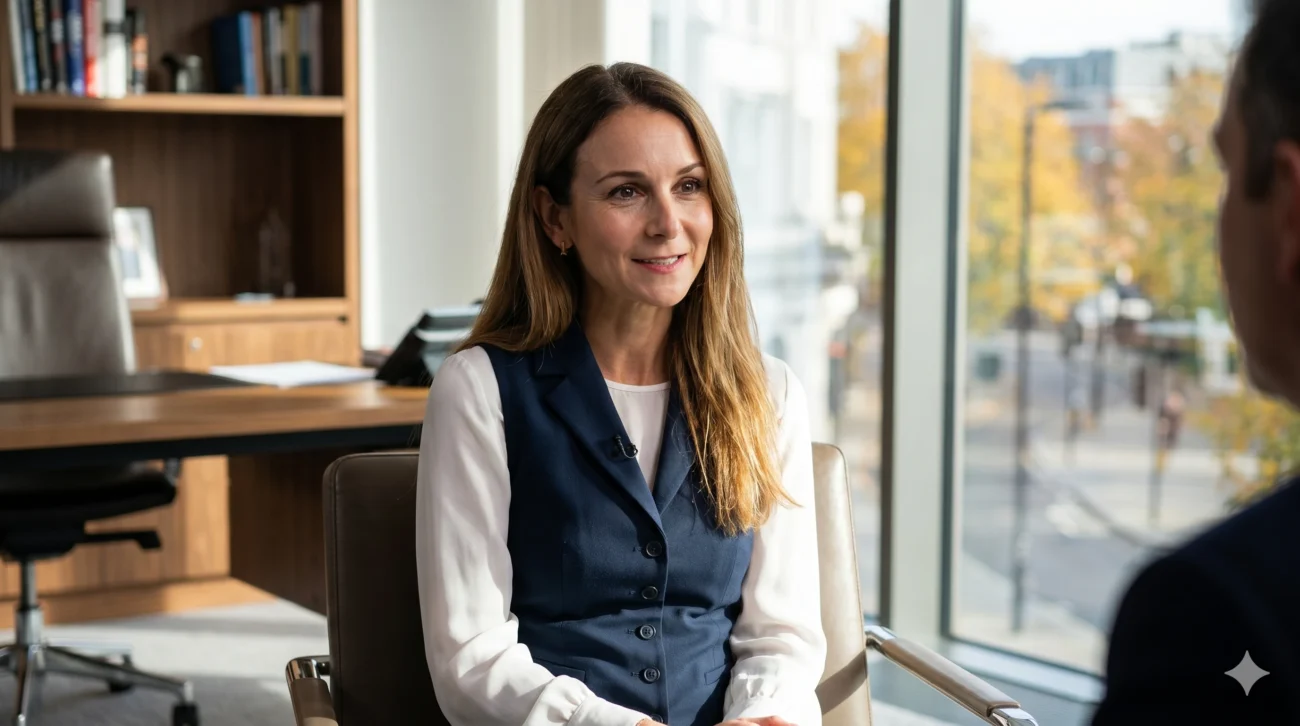
Annabel Denham is the kind of political commentator readers often recognize before they know much about her. Her byline has appeared in British public debate around politics, markets, free speech, business, and the size of the state, and her television appearances have made her a familiar presence to viewers who follow Westminster argument closely. That visibility has also created a steady stream of searches about her personal life, especially one direct question: what is Annabel Denham’s age?
The honest answer is that Annabel Denham’s exact age is not publicly confirmed in the most reliable professional sources. Her public biographies tend to focus on her journalism, policy work, and media commentary rather than her date of birth, family details, or private relationships. That makes her different from celebrities whose birthdays and family lives are heavily documented. It also makes accuracy more important, because the internet often fills gaps with guesses that sound more certain than they are.
What can be said with confidence is that Denham has built a serious career across journalism, Westminster-linked policy work, think-tank communications, and national opinion writing. She has worked with City A.M., The Entrepreneurs Network, the Institute of Economic Affairs, The Spectator, and The Telegraph. Those roles offer a clearer picture of who she is than an unsourced age estimate ever could. Her story is not one of celebrity disclosure, but of a commentator whose influence comes from work, argument, and institutional experience.
Annabel Denham Age: What Is Actually Known
Annabel Denham’s age has not been officially confirmed in the strongest public profiles connected to her career. There is no widely verified date of birth in the standard professional biographies that identify her as a journalist, columnist, political commentator, and former think-tank communications director. For that reason, any exact age attached to her name should be treated carefully unless it comes from her own statement or a credible biographical record. A responsible biography should not pretend certainty where the public record is thin.
This does not mean Denham is an unknown figure. It means her public identity has been built around her career rather than around personal disclosure. Many journalists, editors, commentators, and policy professionals keep their age out of their public profiles because it is not central to their work. In Denham’s case, the verified record tells us more about her professional standing than about her private timeline.
Searches for “Annabel Denham age” often come from readers trying to understand where she sits in the British media world. They may have seen her on a politics panel, read one of her columns, or heard her name attached to a debate about economics or conservatism. Age can feel like a shortcut for context, but it is not the best one here. Her career path gives a stronger and fairer sense of her public role.
Early Life and Family Background
Annabel Denham has kept much of her early life away from public view. Her hometown, parents, siblings, and childhood details are not widely documented in reliable public sources. That privacy should be respected, especially because her public career has not depended on a personal origin story. Unlike actors, reality television personalities, or campaign-facing politicians, she has not made family biography a major part of her public brand.
This absence of detail is not unusual in British journalism. Many columnists and editors are visible through their work but private as individuals. Readers may know their views on tax, public spending, elections, or social policy while knowing very little about where they grew up. That line between public argument and private life remains important.
What can be inferred from Denham’s career is that she developed an early interest in politics, business, and public policy. Her work moved through Westminster research, business journalism, entrepreneurship policy, and opinion editing. Those choices point to a professional imagination shaped by institutions, public debate, and the economics of everyday life. They do not, however, allow anyone to invent childhood details that have not been verified.
Education and First Ambitions
Some online biographies have claimed educational details about Annabel Denham, but not every claim is equally well sourced. Because her strongest public profiles focus on career appointments and commentary roles, her education history is less firmly documented than her employment record. This is a useful reminder that biography should not treat repetition across low-quality websites as proof. If a school or university is not confirmed by a reliable source, it should be handled with care.
What is much clearer is the direction of her early ambitions. Denham’s career suggests an interest in the places where politics meets economics. She did not follow a purely newsroom-only route, nor did she remain entirely within party politics or think-tank life. Instead, she moved across all three, which helps explain why her commentary often has a policy edge.
Her first publicly traceable roles placed her near political argument and business debate. Work connected to Parliament and later to business journalism gave her a close view of how policy ideas travel from think tanks and campaigns into newspapers and public discussion. That early mix matters because it became a defining feature of her public voice. Denham is not simply a commentator on party drama; she often writes from the viewpoint of markets, enterprise, regulation, and the limits of government power.
Westminster, Research, and the Move Toward Public Debate
Before becoming better known as a columnist, Denham worked in political research. She has been identified as having worked as a parliamentary researcher for Lord Peter Lilley, a former Conservative cabinet minister. That kind of role is often invisible to the wider public, but it can be formative for someone who later writes about politics. Parliamentary researchers learn how policy is made, how arguments are framed, and how political ideas survive contact with committees, speeches, briefings, and party pressure.
The Westminster environment can also teach a writer what matters behind public performance. Politics is not only about the speech delivered at the dispatch box or the interview clip shared online. It is also about the research note, the amendment, the stakeholder meeting, the quiet briefing, and the choice of which facts to push forward. A researcher who later becomes a commentator carries some of that machinery into their reading of events.
Denham’s later work shows the imprint of that background. Her commentary is often concerned with the practical effect of policy choices, especially where government decisions affect businesses, founders, workers, and taxpayers. That does not mean readers must agree with her conclusions. It means her public arguments are rooted in a world she had already seen from the inside.
City A.M. and Business Journalism
City A.M. was a major step in Denham’s public career. The London-based business newspaper has long served readers interested in finance, markets, entrepreneurship, regulation, and the City’s relationship with government. Denham worked there in senior business and entrepreneurship-focused roles, which gave her a platform connected to the concerns of founders, investors, executives, and policy watchers. That experience sharpened the business-facing side of her journalism.
Business journalism demands a different muscle from pure political commentary. It asks what policies cost, who pays, who benefits, and how companies respond when rules change. It also brings writers closer to people building companies rather than only those regulating them. Denham’s later interest in entrepreneurship and free-market policy fits naturally with that training.
Her time at City A.M. also helped place her within a particular tradition of British economic debate. That tradition is skeptical of heavy regulation, attentive to tax and growth, and interested in how government choices affect private enterprise. Denham did not emerge suddenly as a national commentator. She built a professional base in the world where politics and business speak to each other every day.
The Entrepreneurs Network and Female Founders Forum
After City A.M., Denham became associated with The Entrepreneurs Network, a think tank focused on supporting entrepreneurship and improving policy conditions for founders. Her work there included communications, research, and projects linked to business creation. She has also been associated with the Female Founders Forum, a project focused on women entrepreneurs and the barriers they face. That part of her career is especially important because it shows her work extended beyond commentary into policy advocacy and institutional organizing.
The Female Founders Forum gave Denham a role in one of the more practical debates in British enterprise policy. Women founders have long faced challenges around funding access, networks, mentoring, investor bias, and visibility. A project focused on those issues requires more than slogans. It demands attention to data, founder experience, and the practical ways policy can either widen or restrict opportunity.
This work adds depth to Denham’s public profile. She is often discussed as a political commentator, but her background also includes engagement with entrepreneurship as a lived economic force. That matters because her later arguments about business and regulation were not formed only from newspaper opinion pages. They were shaped through work with organizations trying to influence the conditions under which people start and grow companies.
Institute of Economic Affairs
In 2020, Denham joined the Institute of Economic Affairs as Director of Communications. The IEA is one of Britain’s best-known free-market think tanks, and its work has long influenced debates about taxation, regulation, public spending, education, health policy, and the role of the state. A communications role at that level is not just a press job. It involves shaping how research, argument, and institutional priorities reach journalists, policymakers, supporters, critics, and the wider public.
The appointment placed Denham at the center of a highly contested area of British public life. Free-market think tanks attract both loyal supporters and sharp critics. Supporters see them as defenders of economic liberty and limited government. Critics often challenge their policy influence, funding transparency, or ideological assumptions. Working in that environment requires comfort with scrutiny and a clear sense of message.
For Denham, the IEA role seems to have strengthened the connection between policy advocacy and media debate. She was no longer only writing about politics from the outside. She was helping a major institution communicate its ideas in a noisy political climate. That experience likely deepened the media fluency that later shaped her work at national newspapers and on broadcast panels.
The Telegraph and National Commentary
Denham is now most widely known for her work connected to The Telegraph, where she has been identified as a senior political commentator and has also held opinion-editing responsibilities. The Telegraph is one of Britain’s most influential conservative-leaning newspapers, with a readership that follows politics, monarchy, culture, markets, and public affairs closely. To write and edit in that environment is to take part in the daily argument over the country’s direction. Denham’s role there has made her much more visible to readers outside specialist policy circles.
Her Telegraph work sits at the meeting point of ideology and news judgment. Political commentary is not the same as straight reporting, but good commentary still depends on facts, timing, and a feel for what matters. Denham’s background in business journalism and think-tank communications gives her a particular angle on national events. She often approaches politics through questions of state power, institutional failure, economic incentive, and cultural change.
The Telegraph also gives commentators a platform that can shape debate beyond its own readership. Columns are clipped, quoted, challenged, circulated, and discussed by politicians, activists, broadcasters, and rival writers. Denham’s association with the paper has helped place her among the recognizable voices in Britain’s center-right media conversation. That public role explains why more readers now search for her biography, age, and personal background.
Work With The Spectator and Broadcast Media
Denham has also been linked with The Spectator, including its Coffee House political coverage and related commentary spaces. The Spectator occupies a distinct place in British public life, mixing political analysis, essays, culture, criticism, and ideological debate. A connection with that publication signals a place inside a specific conversation about conservatism, liberalism, markets, and the future of the right. For Denham, it extends her reach beyond newspaper columns alone.
Broadcast appearances have widened that reach further. Commentators who appear on television or radio are judged differently from writers who remain only on the page. They must compress arguments, respond under pressure, and hold their ground in conversation with people who may disagree sharply. Denham’s broadcast presence has helped make her face and voice more familiar to politically engaged audiences.
That visibility comes with tradeoffs. Television can introduce a commentator to new readers, but it can also flatten complex views into short clips. A column allows more space for evidence and structure, while a panel exchange rewards quickness and clarity. Denham’s public image has been shaped by both formats, which helps explain why curiosity about her personal biography has grown.
Public Image and Political Outlook
Annabel Denham is generally associated with free-market, right-of-center, and small-state arguments. That association comes from her professional history as much as from any single column. City A.M., The Entrepreneurs Network, the Institute of Economic Affairs, The Spectator, and The Telegraph all place her within a recognizable part of British public debate. Her career has unfolded among institutions that care deeply about enterprise, economic liberty, regulation, and the limits of government intervention.
That does not mean every reader sees her the same way. Supporters may view her as a clear and disciplined commentator who understands business and policy. Critics may see her as too aligned with free-market institutions or too skeptical of state intervention. Both responses are part of the job for a political columnist. Public argument invites disagreement, and Denham works in a field where disagreement is often the point.
Her image is also shaped by restraint around private life. She has not built a public persona around family disclosure, celebrity friendships, or lifestyle branding. That gives her a more work-centered public profile than many media personalities. It also means readers looking for personal detail will find less confirmed material than they might expect.
Marriage, Partner, and Private Life
There is no strong public confirmation of Annabel Denham’s marriage, husband, partner, or children in the reliable professional profiles most often associated with her career. Some websites may speculate about her relationship status, but speculation is not biography. Unless Denham has chosen to make those details public in a credible setting, they should be treated as private. A respectful profile should not turn absence of information into rumor.
This boundary is especially important for women in public commentary. Female journalists and broadcasters often face more personal curiosity than male colleagues doing similar work. Questions about age, marriage, family, appearance, and private life can crowd out discussion of their work. Denham’s career is public; her private relationships are not automatically public property.
The best way to handle this is direct and simple. There is no verified public record that allows a responsible article to state whether Annabel Denham is married or has children. What is known is that she has kept that side of her life out of the main professional record. Readers who want to understand her should begin with her work, not with unconfirmed personal claims.
Net Worth, Income Sources, and Money Claims
Annabel Denham’s net worth is not publicly verified. Any exact figure attached to her name should be treated as an estimate unless supported by financial records, declared assets, company filings, or a reliable report. Many biography websites publish net worth numbers for journalists and commentators, but those figures are often guesses based on job title rather than evidence. In Denham’s case, there is no credible public basis for a precise number.
Her likely income sources are easier to discuss in general terms. She has worked as a journalist, editor, columnist, communications director, policy professional, and media commentator. Those roles can involve salary, freelance fees, speaking engagements, broadcast fees, or editorial contracts, depending on the arrangement. But without verified figures, the responsible approach is to describe categories of income rather than pretend to know her personal finances.
This matters because net worth claims can become part of a false public record. A number repeated across search results can look official even if it began as a guess. For Denham, the honest answer is that her professional life suggests established media and policy earnings, but her personal wealth is not publicly known. That is a fact, not a gap that needs to be filled with fantasy.
Career Standing and Influence
Denham’s career standing comes from the combination of institutions she has moved through. She has experience in parliamentary research, business journalism, entrepreneurship policy, free-market think-tank communications, opinion editing, and political commentary. Few commentators follow exactly that route, and the sequence helps explain her public voice. She understands both the newsroom and the policy shop, which gives her arguments a particular shape.
Her influence is not the kind measured by celebrity awards or entertainment metrics. It is better understood through bylines, editorial roles, broadcast invitations, and proximity to policy debate. Commentators influence public life by framing arguments, testing political assumptions, and giving readers language for what they already feel or oppose. Denham has done that within a specific ideological and media tradition.
That tradition has been especially active in Britain during years of economic strain, leadership changes, Brexit aftershocks, culture-war argument, and debate over the size of the state. Denham’s work belongs to that period. Whether readers agree with her or not, she has become one of the recognizable voices in the conversation about what conservatism, markets, and government should look like now.
Recent Work and Current Status
Annabel Denham remains active as a commentator and journalist. Her public profile is tied most strongly to political commentary, opinion writing, and media appearances. She continues to be associated with major outlets and debates in the British public sphere. That current visibility is why searches around her age and biography continue to appear.
Her present role should be seen as the result of several earlier stages rather than a sudden arrival. Westminster research gave her a political foundation. City A.M. gave her business journalism experience. The Entrepreneurs Network and the IEA gave her policy and communications depth. The Telegraph and related media platforms brought those strands into wider public view.
But here’s the thing. The public knows a great deal about Denham’s professional journey and relatively little about her private life. That combination is not a flaw in the record; it is part of how she has chosen to exist in public. Her work is available for judgment, while her age, family life, and finances remain largely outside confirmed public knowledge.
Why Annabel Denham Age Became a Search Topic
Age searches often grow around people who become visible before they become widely biographed. Denham fits that pattern. She is familiar enough to be searched but private enough that basic personal details are not neatly packaged on a single official page. Readers then turn to search engines looking for a quick answer.
The phrase “Annabel Denham age” also reflects a broader habit in online reading. People want to place public figures into a timeline. They want to know whether someone is young for their role, established by long experience, or part of a rising generation of commentators. That instinct is understandable, but it can produce weak information if websites rush to satisfy the query.
The more useful answer is not an invented age but a verified context. Denham is an experienced British journalist and political commentator with a career spanning media, think tanks, entrepreneurship policy, and Westminster-linked work. Her exact age is not confirmed. Her public record, however, is substantial enough to understand why she matters.
Frequently Asked Questions
How old is Annabel Denham?
Annabel Denham’s exact age is not publicly confirmed in reliable professional sources. Her public profiles generally focus on her journalism, commentary, and policy work rather than her date of birth. For that reason, any exact age published without a clear source should be treated as unverified.
The safest and most accurate wording is that Annabel Denham’s age is not publicly known. She is an established professional with experience across journalism, think tanks, and political commentary. Her career record gives readers better context than a guessed birth year.
What is Annabel Denham known for?
Annabel Denham is known as a British journalist, political commentator, columnist, and former think-tank communications director. She has been associated with The Telegraph, The Spectator, the Institute of Economic Affairs, The Entrepreneurs Network, and City A.M. Her work often centers on politics, business, markets, entrepreneurship, and the role of government.
She is also recognized for appearing in media discussions about British politics and public affairs. Her background gives her a profile that sits between journalism and policy advocacy. That mix has made her a familiar voice in center-right political debate.
Is Annabel Denham married?
Annabel Denham’s marital status is not clearly confirmed in reliable public professional sources. There is no strong basis for stating that she is married, has a husband, or has children unless she has publicly confirmed those details in a credible setting. Personal claims on low-quality biography websites should not be treated as fact.
This is a case where privacy and accuracy point in the same direction. Denham’s public record is focused on her work, not her relationships. A responsible biography should respect that boundary.
What did Annabel Denham do before The Telegraph?
Before her Telegraph-linked profile became more prominent, Denham worked in political research, business journalism, entrepreneurship policy, and think-tank communications. She has been identified with work for Lord Peter Lilley, City A.M., The Entrepreneurs Network, and the Institute of Economic Affairs. Those roles gave her experience across Westminster, business, and public policy.
This background helps explain the focus of her commentary. She often writes and speaks about the effects of government policy on markets, enterprise, and personal freedom. Her career did not begin as a simple newspaper path; it developed across several institutions that shape public debate.
What is Annabel Denham’s net worth?
Annabel Denham’s net worth is not publicly verified. Any exact figure online should be treated as an estimate unless it is backed by credible financial evidence. For journalists and commentators, personal wealth is often guessed from job titles, which is not a reliable method.
Her income has likely come from professional work in journalism, editing, communications, policy, and media commentary. Those categories are fair to identify, but a precise personal wealth figure would be speculative. The responsible answer is that her net worth is not publicly known.
Why is Annabel Denham’s age hard to find?
Annabel Denham’s age is hard to find because she has not made her date of birth a central part of her public biography. Her professional profiles emphasize her roles, columns, and policy background. That is common for journalists and commentators who are known mainly through their work.
The gap has encouraged some websites to publish estimates. But estimates are not proof, especially when they do not cite a strong source. Readers should trust the verified career record and treat exact age claims with caution.
Where is Annabel Denham now?
Annabel Denham remains active in British political commentary and journalism. She is most closely associated with opinion writing and public debate, especially around politics, business, and the role of the state. Her current public image is tied to commentary rather than celebrity-style personal exposure.
Her career continues to reflect the same themes that shaped her earlier work. Those include markets, entrepreneurship, Westminster politics, regulation, and ideological argument. She remains a recognizable voice in the British media conversation.
Conclusion
Annabel Denham’s age may be the search term that brings many readers to her biography, but it is not the fact that best explains her. The more revealing story is the career she has built across Parliament, business journalism, entrepreneurship policy, think-tank communications, and national commentary. Her exact date of birth remains unconfirmed, and that uncertainty should be stated plainly.
What stands out is the consistency of her professional interests. Denham has spent much of her career near the arguments that shape British public life: how much power the state should have, what business needs from government, how free markets should work, and where conservatism goes next. Her path shows someone who moved from research and specialist policy spaces into a wider media role.
The privacy around her personal life also tells us something about the limits of biography. Not every public figure offers the full family-and-childhood story readers have come to expect from celebrity profiles. In Denham’s case, the public record is strongest where it should be strongest: on her work, roles, and public arguments.
That is where readers should place their attention. Annabel Denham is best understood not through a guessed age or unsourced personal claim, but through the institutions she has worked in and the debates she continues to enter. Her biography is still being written in public, column by column and argument by argument.
