
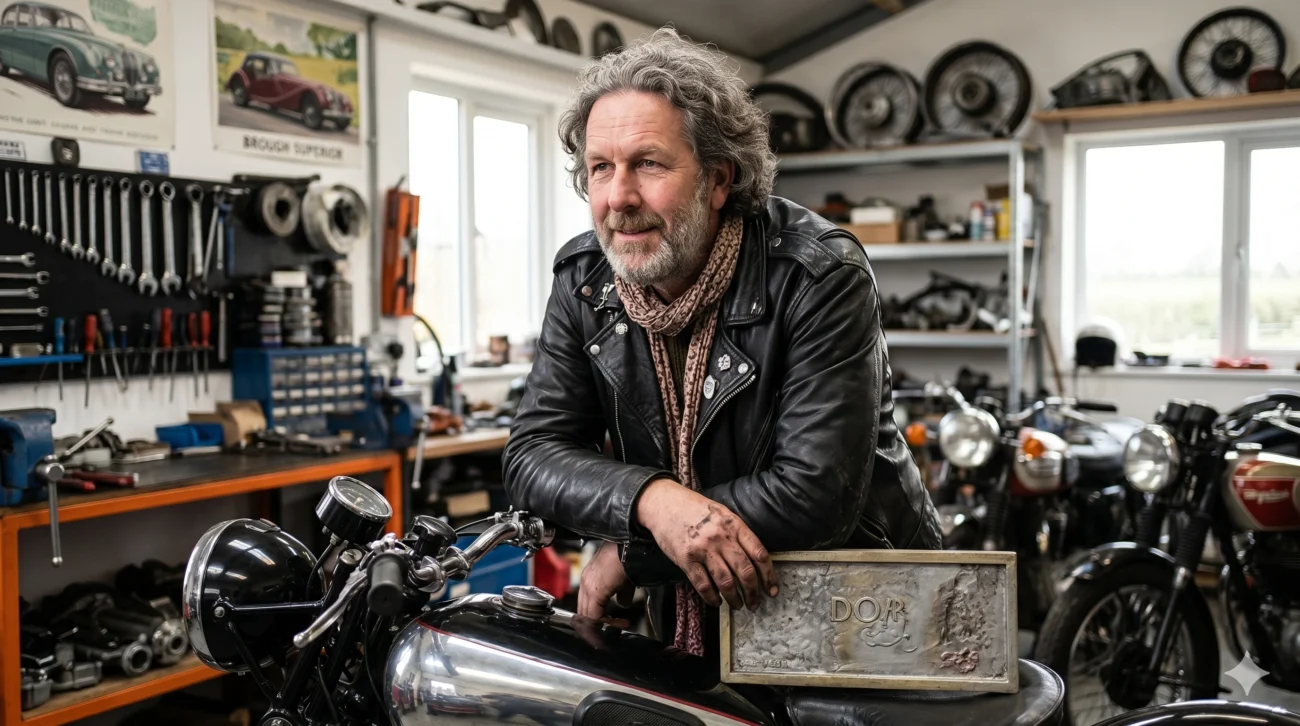
Sam Lovegrove became familiar to British motoring viewers in the most Sam Lovegrove way possible: not by chasing the camera, but by looking as if he had wandered into shot from a workshop where something more interesting needed fixing. Beside Henry Cole, he brought a calm, dry, mechanically fluent presence to programmes about old motorcycles, forgotten vehicles, sheds full of parts, and the strange optimism that makes people drag dead machines back into daylight. He was never the loudest person on screen, and that became part of the appeal. Viewers trusted him because he sounded less like a presenter than a man who knew exactly which bolt was about to shear.
That is why people search for sam lovegrove with a particular kind of curiosity. They want to know who he is, where he came from, whether he still works with Henry Cole, what happened to his role on Shed & Buried, whether he is married, and how much money he has made from television and restoration. Some of those questions have clear answers; others run into the limits of what Lovegrove has chosen to make public. The honest biography of Sam Lovegrove is therefore not a celebrity exposé, but the story of a highly skilled British engineer who became a cult television figure while keeping much of his private life firmly off-screen.
Who Is Sam Lovegrove?
Sam Lovegrove is a British motorcycle engineer, restorer, collector, and television personality best known for his appearances with Henry Cole on shows including Shed & Buried, Find It Fix It Drive It, Junk & Disorderly, and The Motorbike Show. His public identity is rooted in mechanical skill rather than show-business polish. On screen, he is usually the practical eye in the room, the person weighing whether a neglected machine is worth saving, what it will take to repair, and whether the enthusiasm around it has outrun the facts. That role made him stand out in a genre that can sometimes turn restoration into theatre.
His reputation also extends beyond television. Lovegrove has long been associated with classic motorcycles and, in particular, Brough Superior, one of the most storied names in British motorcycling. He has been described in marque-related material as a leading expert in restoring Brough Superior machines, a serious distinction in a field where knowledge is earned slowly and judged by other specialists. Brough Superior motorcycles are rare, valuable, and historically important, so restoration work around them demands care as well as confidence. Lovegrove’s connection with that world helps explain why his screen authority feels earned.
Unlike many television personalities, Lovegrove has not built a public profile around constant interviews, social media disclosure, or lifestyle branding. That privacy has created a gap between his visibility and the amount of confirmed biographical detail available about him. The gap is often filled online with unverified claims about his age, marriage, family, health, and net worth. A careful profile has to resist that temptation and stay with what can be responsibly said.
Early Life and Family Background
Reliable public information about Sam Lovegrove’s early life is limited. His exact date of birth, parents, childhood home, and schooling have not been widely documented in primary public sources. Some websites offer estimates or casual claims, but those details are often repeated without clear sourcing. For a person who has chosen a relatively private public life, it is better to acknowledge the absence of confirmed information than to pretend the record is fuller than it is.
What can be inferred from his career is that Lovegrove’s formative world was shaped by machines, workshop practice, and the culture of hands-on repair. His later work shows the habits of someone who learned through direct contact with engines, frames, parts, tools, and the slow discipline of making things work. That kind of expertise rarely comes from casual interest alone. It usually reflects years of exposure, mistakes, observation, and patient repetition.
Lovegrove belongs to a British tradition of engineer-restorers whose knowledge is practical before it is formal. That does not mean he lacks technical depth; it means his public value comes from applied judgment. The way he talks about old motorcycles suggests a person more interested in function and authenticity than display. That attitude would become central to his television appeal.
His family life is also largely private. There is no reliable public record that confirms detailed information about a spouse, children, or domestic arrangements. Some readers may find that frustrating, but privacy is not secrecy in any meaningful scandalous sense. It is simply the boundary Lovegrove appears to have maintained between his public work and his personal life.
The Making of a Motorcycle Engineer
Sam Lovegrove’s career makes most sense when understood through the world of classic motorcycle restoration. This is not a field where status comes easily. People who work on rare machines are judged by whether they understand originality, mechanical integrity, period detail, and the consequences of bad decisions. A restorer may have to choose between preserving a tired original part, repairing it, remaking it, or replacing it, and each choice can affect a machine’s value and historical honesty.
Lovegrove’s reputation is especially tied to Brough Superior, a marque that carries unusual weight in motorcycle history. Founded by George Brough in the early twentieth century, Brough Superior became associated with speed, luxury, engineering ambition, and celebrity ownership. The bikes were famously expensive in their day and remain prized by collectors. Restoring one is not simply a matter of getting it running; it involves understanding what the machine was, how it was built, and how far a restorer should go.
That is where Lovegrove’s professional standing matters. His name has been connected with Brough Superior restoration, collecting, and specialist engineering, including high-profile work linked to the marque’s modern revival and record efforts. In 2013, Brough Superior returned to the Bonneville Salt Flats with machines and riders connected to a new chapter in the brand’s story. Lovegrove was publicly associated with engineering work around that effort, which placed him in a demanding environment far removed from the gentle pace of television rummaging.
Bonneville is a useful marker in any account of Lovegrove’s career because it shows the difference between appearance and performance. A motorcycle prepared for record work must do more than look historically appealing. It has to survive speed, heat, load, vibration, and the unforgiving clarity of a timed run. Lovegrove’s involvement in that setting supports the view that his reputation was built on engineering substance, not just television charm.
Working With Henry Cole
For the general public, Sam Lovegrove is most closely linked with Henry Cole. Cole is a presenter, producer, author, and motorcycle enthusiast whose programmes often mix travel, restoration, collecting, and British eccentricity. Lovegrove became one of his most memorable screen partners because their temperaments worked well together. Cole usually brought the outward energy and appetite for the find, while Lovegrove supplied the technical caution and workshop realism.
Their partnership did not feel manufactured in the way some television pairings do. It had the rhythm of people who had spent real time around machines and knew how to disagree without turning every exchange into conflict. Lovegrove could puncture overenthusiasm with a look, a short comment, or a practical objection. Cole, in turn, could pull the story forward and make the hunt feel alive.
That combination suited the programmes they made together. In shows built around old bikes, vans, tractors, military vehicles, workshop clutter, and half-forgotten treasures, the viewer needs both excitement and restraint. Too much enthusiasm and every pile of rust becomes treasure. Too much caution and the adventure dies before the first negotiation. Cole and Lovegrove worked because they occupied those two poles without seeming trapped by them.
Their friendship has also been part of the appeal, though outsiders should be careful about assuming too much from television chemistry. Publicly, they have continued to be associated through motoring and motorcycle content even after Lovegrove’s role shifted in certain shows. There is no solid public evidence of a feud or dramatic split. The better reading is that the working relationship evolved, as television partnerships often do.
Shed & Buried and Television Breakthrough
Shed & Buried gave many viewers their first proper introduction to Sam Lovegrove. The premise was simple and effective: Henry Cole and Lovegrove travelled around Britain looking through sheds, barns, garages, and private collections for old machinery and motoring objects worth buying, fixing, and selling. It tapped into a powerful fantasy shared by many enthusiasts. Somewhere, under a tarp or behind a stack of boxes, there might be a forgotten motorcycle or rare part waiting for the right person to recognize it.
Lovegrove’s role was essential because the show needed more than enthusiasm for discovery. He assessed condition, feasibility, repair needs, and whether the numbers made sense. The pleasure of watching him came from his ability to cut through the romance of a find without killing it completely. He understood why a rusty old bike might excite someone, but he also understood the cost of being wrong.
His screen manner was distinctive. He did not appear to be performing expertise, and he rarely seemed interested in dominating a scene. Instead, he gave the impression of someone thinking through the problem while the camera happened to be present. That quietness made his comments land more strongly, because viewers learned to hear them as judgments rather than filler.
As Shed & Buried continued, the programme’s lineup and public presentation changed, and other well-known figures became associated with the show. This has led some fans to ask whether Lovegrove left or was replaced. The public record does not support a dramatic explanation. It shows a television format that changed over time and a specialist who did not remain in the same visible role forever.
Find It Fix It Drive It
Find It Fix It Drive It gave Sam Lovegrove and Henry Cole a format built less around resale and more around challenge. The pair searched for old vehicles, prepared them, and put them back to use in ways that tested more than appearance. That structure suited Lovegrove because it showed restoration as a practical act rather than a cosmetic reveal. A machine had to do something after the work was finished.
The programme also gave viewers more time with the mechanical process. A vehicle that looks charming in a shed may reveal serious problems once it is inspected properly. Brakes, bearings, electrics, fuel systems, tired engines, and worn frames all have a way of humbling initial optimism. Lovegrove’s function was to keep the project connected to reality.
What made the show satisfying was the sense that the machines were not merely props. They had histories, limitations, and personalities of their own. Lovegrove treated them with the mix of affection and skepticism that experienced mechanics often develop. He could appreciate a vehicle’s appeal without pretending it would be easy to save.
The series also widened his public image beyond motorcycles alone. Although bikes remained central to his identity, Lovegrove was shown in the wider world of old vehicles and mechanical restoration. That mattered because it revealed a broader fluency. He was not just a collector with one narrow passion, but a practical engineer comfortable around old machinery in many forms.
Junk & Disorderly and the Wider Motoring World
Junk & Disorderly placed Lovegrove within a larger group of restorers and motoring personalities around Henry Cole. The show followed searches through auctions, sales, sheds, and collections, with the aim of finding items that could be restored, improved, or sold. In this setting, Lovegrove was part of a wider ensemble rather than only one half of a double act. Even so, his presence carried the same value: knowledge that could turn a hopeful purchase into a sensible one.
The programme also reflected a growing television appetite for salvage culture. Audiences like watching neglected things become useful or desirable again. There is pleasure in the transformation, but there is also comfort in the idea that old objects still have value if someone understands them. Lovegrove fit that world naturally because he seemed less interested in spectacle than in the practical question of what could be done.
His appearances alongside figures such as Allen Millyard and Guy Willison placed him among people with their own strong reputations in motorcycle and custom-building circles. That company matters. These are not general lifestyle presenters parachuted into a mechanical format. They are people who have built, modified, restored, and lived with machines long before the edit suite shaped the story.
Lovegrove’s contribution in that mix remained understated. He was not there to compete for attention. He was there because the work needed credible eyes and credible hands. That is a recurring pattern in his public career.
Brough Superior, Bonneville, and Serious Specialist Work
Sam Lovegrove’s association with Brough Superior is one of the most important parts of his biography. Brough Superior is not just a brand name to classic motorcycle enthusiasts; it is a symbol of British engineering ambition and pre-war glamour. The machines were famously known as the “Rolls-Royce of Motorcycles,” a phrase that captured both their quality and their cost. To be trusted around them requires more than enthusiasm.
Lovegrove has been linked publicly with the restoration and specialist knowledge of Brough Superior motorcycles. That connection places him in a small community where credibility is tested by results and memory. Owners, collectors, and historians tend to know which restorers understand a marque properly. Mistakes can be expensive, visible, and hard to undo.
His involvement in Brough Superior’s Bonneville-related activity adds another layer to that reputation. In 2013, Brough Superior machines and riders returned to the Salt Flats in a record-setting context connected to the brand’s modern story. Lovegrove’s name appears in that chapter as an engineer associated with the effort. That matters because Bonneville work demands preparation under pressure.
The Bonneville story also helps explain the respect many enthusiasts have for him outside television. It is one thing to talk fluently about an old motorcycle in front of a camera. It is another to help prepare machines for high-speed runs in conditions that punish weak assumptions. Lovegrove’s public identity sits at that meeting point between historic machinery and real performance.
Public Image and Personality
Sam Lovegrove’s public image is built around restraint. He does not present himself as a celebrity mechanic with a catchphrase, a loud persona, or a constant need to be liked. His appeal is quieter and more durable. He looks like someone who would rather be right than dramatic.
That quality has made him popular with viewers who value authenticity in factual television. People who work on vehicles can often tell when a presenter is only repeating information provided off-camera. Lovegrove gives the opposite impression. He seems to think from experience, and that makes even small observations feel useful.
His humor is also part of the package. It is dry rather than broad, and it tends to arise from the absurdity of old machines, hopeful purchases, and Henry Cole’s enthusiasm. He can be funny without breaking the spell of the work. That balance is harder than it looks.
The public affection for Lovegrove also comes from his resistance to overexposure. Because he has not turned his life into an open book, fans tend to project steadiness and integrity onto him. Projection is not proof, of course, but it reveals the kind of figure he has become. In viewers’ minds, he represents craft, modesty, and a vanishing type of practical knowledge.
Marriage, Children, and Private Life
Many readers want to know whether Sam Lovegrove is married or has children. The responsible answer is that those details are not clearly confirmed in reliable public sources. Some online profiles make claims about his family life, but they often do so without evidence that meets a serious editorial standard. Repeating those claims as fact would be unfair to him and misleading to readers.
Lovegrove appears to have made a deliberate choice to keep his private life separate from his public work. That is increasingly rare for someone with a television profile, but it is not unusual among specialist craftspeople who become known through factual programming. They may be public in their work and private in everything else. Lovegrove fits that pattern.
There is also no good reason to treat the absence of personal detail as suspicious. Some public figures cultivate mystery; others simply do not volunteer information that has nothing to do with their work. In Lovegrove’s case, the available evidence points to the latter. His professional life is visible because it is part of television and motorcycle culture, while his family life remains his own.
A biography can still be complete without forcing those details. The central story of Sam Lovegrove is not a romance, scandal, or dynastic family narrative. It is the story of a man whose skill brought him to public attention and whose privacy has remained intact despite that attention.
Net Worth, Income, and Business Interests
Sam Lovegrove’s net worth is not publicly confirmed. Online estimates should be treated with caution because they often rely on guesswork, repeated assumptions, and the general idea that anyone on television must have a neatly calculable fortune. There is no reliable public source that establishes a precise figure for his wealth. Any specific number should therefore be described as an estimate, not a fact.
His likely income sources are easier to discuss in broad terms. Lovegrove has earned public recognition through television appearances, motorcycle restoration, specialist engineering, and work connected to classic vehicles. Expert restoration, especially involving rare motorcycles, can be a valuable profession, but income varies widely depending on projects, ownership structures, parts, labor, and business arrangements. A person may handle valuable machines without personally owning assets equal to their market prices.
Television work can also be misunderstood. Appearing on factual motoring shows does not automatically translate into celebrity-level earnings. Fees depend on contracts, production budgets, episode counts, rights, and the person’s role. Lovegrove’s public profile is strong within a niche audience, but he is not a mass-market celebrity in the usual sense.
The more important financial story is the value of his expertise. Specialist knowledge around rare motorcycles can create opportunities that are not visible to casual viewers. It can involve restoration commissions, advice, sourcing, preparation, and historically sensitive work. That kind of career may not produce public wealth headlines, but it can command deep respect in the right circles.
Setbacks, Rumors, and Viewer Questions
The main confusion around Sam Lovegrove comes from changes in his television visibility. Viewers who knew him from earlier runs of Shed & Buried have noticed that later public materials and episodes have emphasized other collaborators. That has led to online questions about whether he left, whether he fell out with Henry Cole, or whether health issues were involved. The problem is that strong public evidence for those claims is lacking.
A careful reading suggests a less dramatic explanation. Television shows change casts, formats, schedules, and production needs over time. Specialists also have their own work outside filming. Lovegrove’s continuing association with Henry Cole-related content weakens the idea of a clean break or feud.
Health rumors should be handled with even more care. Unless a person or a reliable source has confirmed a medical matter, it should not be treated as public fact. Lovegrove has not built his public identity around personal disclosure, and there is no need to invade that boundary to explain a shift in screen appearances. The absence of a regular television role is not evidence of illness.
The truth is, the internet often punishes private people by turning silence into speculation. Lovegrove’s case shows how quickly curiosity can become biography-by-assumption. A fair profile should say what is known, mark what is not known, and avoid filling the space with confident invention.
Where Sam Lovegrove Is Now
Sam Lovegrove appears to remain connected to classic motorcycles, specialist engineering, and Henry Cole’s wider motoring world. He has continued to be referenced in recent online motorcycle content associated with Cole, including conversations and classic bike material. That suggests a continuing professional and personal connection to the scene that made him familiar. It does not mean he is trying to return to constant television visibility.
His current status is best described as selectively public. He remains known, respected, and searched for, but he does not appear to be pursuing the kind of daily online presence that turns a TV figure into a lifestyle personality. That choice may limit the amount of biographical detail available, but it also protects the qualities people liked about him in the first place. He seems most credible when attached to work, not self-promotion.
For fans, that can be both satisfying and frustrating. They may want more appearances, more updates, and more explanation. Yet Lovegrove’s appeal was always tied to the impression that he had other things to do besides being famous. He belonged to the workshop before he belonged to television.
That is probably the most accurate way to understand his place now. Sam Lovegrove is not a vanished celebrity or a mystery to be solved. He is a skilled engineer who had a distinctive television chapter and remains part of the culture of classic motorcycles and restoration.
Why Sam Lovegrove Still Matters
Sam Lovegrove matters because he represents a kind of expertise that television can show but not easily create. Viewers responded to him because he did not seem manufactured for the screen. He had the bearing of a person formed by work, not publicity. That made him unusually believable in a format where belief is everything.
His career also matters because restoration culture has become more visible while real mechanical knowledge has become less common in daily life. Many people now own machines they cannot repair and use technology they are not expected to understand. Watching someone like Lovegrove work offers a different pleasure. It reminds viewers that skill can still be physical, local, and deeply personal.
In the classic motorcycle world, his importance is more specific. He is associated with rare machines, serious restoration, and a level of judgment that cannot be learned from enthusiasm alone. That kind of standing is not always obvious to a casual viewer, but it gives his screen appearances their authority. He was not pretending to be an expert for television; television found a way to use the expert he already was.
His continued appeal is also emotional. People like watching competent people do difficult things without making a fuss. Lovegrove’s calm, slightly guarded presence gives viewers permission to enjoy the work itself. In a noisy media culture, that is a surprisingly powerful thing.
Frequently Asked Questions
Who is Sam Lovegrove?
Sam Lovegrove is a British motorcycle engineer, restorer, collector, and television personality. He is best known for appearing with Henry Cole on motoring programmes such as Shed & Buried, Find It Fix It Drive It, Junk & Disorderly, and The Motorbike Show. His reputation comes from practical engineering knowledge, especially around classic motorcycles and Brough Superior machines. He is admired for his calm manner, dry humor, and credible workshop expertise.
What is Sam Lovegrove famous for?
Sam Lovegrove is famous for bringing real mechanical authority to British motoring television. Viewers know him as Henry Cole’s technically minded partner in shows built around finding, fixing, and valuing old vehicles. Among motorcycle enthusiasts, he is also known for his association with Brough Superior restoration and specialist engineering. His fame is niche but strong, especially among people who care about classic bikes and restoration culture.
Did Sam Lovegrove leave Shed & Buried?
Sam Lovegrove’s visible role on Shed & Buried changed as the programme developed and other collaborators became more prominent. There is no reliable public evidence that his absence from later material was caused by a feud or scandal. Television formats often shift, and specialists may also choose or need to focus on other work. The safest answer is that his role evolved rather than that he disappeared under dramatic circumstances.
Are Sam Lovegrove and Henry Cole still friends?
Public evidence suggests Sam Lovegrove and Henry Cole have remained connected through motorcycle and media projects. They have continued to appear in or be associated with Henry Cole-related content after their best-known television work together. That said, the details of their private friendship are not something outsiders can fully know. What can be said is that there is no solid public evidence of a serious falling-out.
Is Sam Lovegrove married?
Sam Lovegrove has not publicly confirmed detailed information about his marital status or family life in widely available reliable sources. Some websites make claims about a wife or children, but those claims are often not supported by strong evidence. Because Lovegrove has kept his private life separate from his public work, responsible biographies should avoid presenting those details as established fact. His known public story is centered on engineering, restoration, and television.
What is Sam Lovegrove’s net worth?
Sam Lovegrove’s net worth has not been reliably confirmed. Online estimates should be treated as guesses unless they provide clear evidence, which most do not. His income likely comes from a mix of restoration work, specialist motorcycle expertise, television appearances, and related projects. A precise figure would be misleading without verified financial records or direct disclosure.
What is Sam Lovegrove doing now?
Sam Lovegrove appears to remain involved in classic motorcycles, specialist engineering, and selected media work linked to Henry Cole’s motoring world. He does not seem to maintain a heavily public celebrity profile, which fits the private image many viewers associate with him. Fans may see him less often than they did during the earlier Shed & Buried years, but he remains a respected figure among viewers and motorcycle enthusiasts. His current public identity is best understood as workshop-first and selectively visible.
Conclusion
Sam Lovegrove’s biography is unusual because its strongest parts are not the usual celebrity markers. The public record does not offer a neatly packaged childhood, a list of romantic milestones, or a verified personal fortune. Instead, it offers something more grounded: a career built around skill, judgment, old motorcycles, restoration work, and a television presence that felt credible because it was never too polished.
His privacy has left room for rumor, but it has also preserved the dignity of his public image. Lovegrove became known for what he could do, not for what he chose to reveal about himself. That distinction matters in a media culture that often treats exposure as achievement. He showed that a person can become familiar without becoming fully available.
The enduring interest in sam lovegrove comes from trust. Viewers trust the way he looks at a machine, the way he measures enthusiasm against reality, and the way he lets knowledge speak without shouting. For classic motorcycle enthusiasts, that trust is connected to serious restoration work and rare machinery. For television viewers, it is connected to the pleasure of watching competence in action.
Sam Lovegrove still matters because he represents craft in a public space that often rewards performance over substance. His story is not about sudden fame or manufactured drama. It is about a private engineer whose work, manner, and judgment made him memorable, and whose best-known role may always be the one that suited him most: the person in the shed who could tell whether the dream was worth saving.
