
Josephine Burge became known to the public through one of the most unruly and unforgettable figures in British cinema: Oliver Reed. He was the hard-drinking actor with the dangerous charm, the booming laugh, the tabloid reputation, and the talent that could still silence a room when the cameras rolled. She was the much younger woman who married him in 1985 and remained his wife until his sudden death in Malta in 1999. Her story is not a conventional celebrity biography, because Josephine Burge did not chase fame, build a public persona, or turn her marriage into a career.
That is exactly why people still search her name. Burge stands at the quiet edge of a loud public life, linked forever to Reed’s final years, his late domestic chapter, and the myth that grew around him after Gladiator. The facts about her are limited, and responsible writing has to respect that limit. What can be told is the story of a private woman who became part of British film history because of whom she loved and married.
Who Is Josephine Burge?
Josephine Burge, also known after marriage as Josephine Reed, is best known as the second wife and widow of English actor Oliver Reed. She married Reed in 1985 in Surrey, after a relationship that had already attracted public attention because of their age difference. Reed was already a famous actor by then, with a long screen career and a reputation that often made headlines beyond his film work. Burge, by contrast, was not a public performer or media figure with a large independent profile.
Most reliable references to Josephine Burge appear in connection with Reed’s personal life. She is named in reports about their wedding, in accounts of Reed’s later years, and in coverage after his death in 1999. That means her biography must be written with care, because many details that readers may expect are not publicly confirmed. There is no good reason to invent a childhood, career path, or private family history where the record does not support it.
The clearest public facts are these: Josephine Burge married Oliver Reed in 1985, stayed married to him until his death, and lived through the last long chapter of his life. She became connected to a man whose fame was built on both real acting power and public excess. Her own life, though, appears to have remained largely private. That contrast is the heart of why her name still invites curiosity.
Early Life and Public Background
Very little has been reliably published about Josephine Burge’s early life. Her exact birth date, parents, schools, hometown, and childhood interests are not widely documented in dependable public sources. Some online profiles repeat claims about her age or background, but many do so without showing records or interviews. A careful article should not treat those claims as fact simply because they have been copied often.
What is broadly reported is that Burge was 21 when she married Oliver Reed in 1985. Contemporary coverage also described the couple as having been together for several years before the wedding. That detail has drawn attention because it places the start of their relationship while she was still very young and Reed was already in his early forties. It is one of the few early-life details about Burge that appears repeatedly in public accounts.
Because Burge did not build a separate public career before her marriage, her early story remains mostly outside the public archive. That may frustrate readers looking for a full cradle-to-present profile, but it also tells us something important. She was not a celebrity whose life had been documented from the beginning. She became visible because the man she married was already famous.
Oliver Reed Before Josephine Burge
Oliver Reed was born Robert Oliver Reed in Wimbledon, London, in 1938. He became one of the most physically commanding British actors of his generation, known for performances that could be brooding, explosive, seductive, or frightening. His best-known films include Oliver!, Women in Love, The Devils, The Three Musketeers, Tommy, and later Gladiator. By the time Josephine Burge entered his public story, Reed had already lived several careers’ worth of fame, scandal, and reinvention.
Reed’s image was never only about acting. He became known for heavy drinking, television appearances that could spin out of control, and a public masculinity that both fascinated and alarmed the press. The British media often treated him as a living character, half serious actor and half walking provocation. That made his private relationships unusually visible, even when the people around him had not chosen fame for themselves.
Before marrying Burge, Reed had already been married to Kate Byrne and had a son, Mark. He also had a daughter, Sarah, from a relationship with dancer Jacquie Daryl. This family history matters because it places Burge within an existing personal life, not at the beginning of Reed’s adult story. She entered a world already shaped by fame, family ties, money pressures, public judgment, and long-running habits.
How Josephine Burge and Oliver Reed Became a Couple
Josephine Burge and Oliver Reed’s relationship became known partly because of the large age gap between them. Reports around their wedding said the couple had been together for about five years before marrying. Reed was in his forties during that period, while Burge was much younger. That difference drew criticism, and it remains one of the main reasons their relationship is discussed today.
It is easy to reduce the relationship to that single detail, but doing so can flatten the real people involved. The age gap is part of the record and should not be avoided. At the same time, Burge herself did not give the public a long account of what the relationship felt like from inside it. Without her own detailed testimony, the fairest approach is to state the facts clearly and avoid pretending to know her inner life.
Reed was not an ordinary older boyfriend; he was a famous man with a powerful personality and a public reputation for excess. That context shaped how the relationship was seen by outsiders. For some, it looked romantic and defiant; for others, it raised obvious questions about youth and power. Both reactions belong to the public history of the couple, but neither gives a complete picture of Burge herself.
The 1985 Wedding in Surrey
Josephine Burge married Oliver Reed in 1985 in the Epsom area of Surrey. The wedding was reported as a civil ceremony rather than a lavish celebrity event. Reed was in his mid-forties, while Burge was reported to be 21. The marriage formalized a relationship that had already been watched and judged by parts of the press.
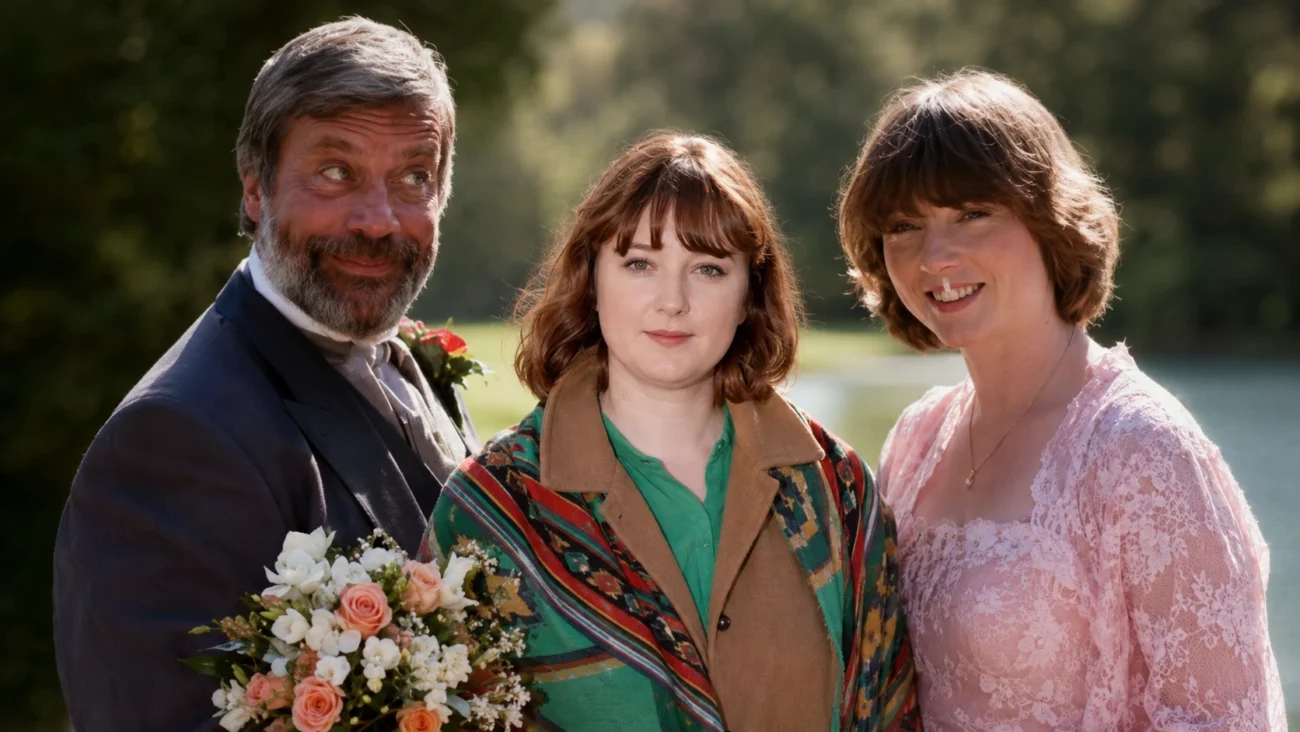
Their wedding photographs show the public version of the day: Reed, already recognizable as one of Britain’s most forceful screen actors, standing beside a much younger bride who would soon be folded into his public story. Those images have continued to circulate through photo archives and biographical articles. They are among the most visible records of Josephine Burge’s life. For many readers, the wedding is the first and sometimes only clear image they encounter of her.
The marriage also gave Burge a new public identity as Josephine Reed. Yet she did not become a regular fixture in the entertainment pages in the way some celebrity spouses do. There were no constant interviews, no obvious attempt to build a brand, and no steady public campaign around Reed’s career. Her visibility remained tied to him, but it stayed limited.
Marriage to a Larger-Than-Life Actor
Life with Oliver Reed could not have been simple. He was admired by directors and audiences, but he was also known for behavior that could be exhausting, reckless, and self-defeating. His drinking stories followed him everywhere, sometimes overwhelming serious discussion of his work. For the person married to him, that reputation would have been more than a public image; it would have been part of daily reality.
Accounts of Reed’s later life often suggest that his marriage to Josephine Burge brought him some degree of steadiness. That does not mean his difficulties vanished. Reed continued to work, drink, appear in public, and attract stories that blurred the line between performance and chaos. Burge’s role in that period seems to have been private and domestic rather than promotional.
What stands out is the length of the marriage. From 1985 until Reed’s death in 1999, Burge remained his wife through a period when his career had highs, lows, and odd turns. This was not a brief celebrity romance remembered only because of scandal. It was a fourteen-year marriage that lasted until his final day.
Homes, Distance, and Later Life With Reed
During their marriage, Reed and Burge were associated with a quieter life away from the center of London celebrity culture. Reed spent time in places such as Guernsey and later Ireland, and his final years became closely linked with Churchtown in County Cork. That move away from the usual entertainment circuit fits the picture of a man who wanted both attention and escape. It also helps explain why Burge’s public presence remained so limited.
Reed’s connection to Ireland became part of his late-life identity. He was often described as enjoying pub life, local company, and a less polished existence than the world of premieres and interviews. This did not make him anonymous, but it placed him in a different social rhythm. Burge shared that chapter, though she rarely appears as the speaker in public accounts of it.
For readers looking for details about her everyday life, the record is thin. There are no widely known memoirs from Burge, no major interviews that map the marriage room by room, and no large public archive of her own words. That absence should not be treated as mystery for mystery’s sake. It may simply reflect a person who preferred privacy while living beside someone who attracted attention everywhere.
Oliver Reed’s Final Film and Sudden Death
Oliver Reed died on May 2, 1999, in Valletta, Malta, while working on Ridley Scott’s Gladiator. He was 61. His death came before he had finished all of his scenes as Proximo, the former gladiator who owns and trains the film’s hero, Maximus. The production later completed his remaining work using body doubles and digital methods.
The circumstances of Reed’s death became part of film legend almost immediately. Reports focused on his final drinking session, his collapse, and the strange fact that one of his most widely seen late performances arrived after he was gone. For Josephine Burge, though, the public myth was also a private loss. She became Reed’s widow at the moment his career was about to reach a new global audience.
Gladiator was released in 2000 and became a major commercial and awards success. Reed’s performance introduced him to viewers who may not have known his earlier British work. That late surge of attention kept his name alive for a new generation. It also kept Josephine Burge’s name attached to searches about his final years.
Family, Children, and Private Relationships
Josephine Burge is often discussed alongside Oliver Reed’s wider family, but the details should be kept clear. Reed had a son, Mark, from his marriage to Kate Byrne. He also had a daughter, Sarah, from his relationship with Jacquie Daryl. These children were part of Reed’s family story before and during his marriage to Burge.
There is no widely confirmed public record showing that Josephine Burge and Oliver Reed had children together. Some online articles blur this point by naming Reed’s children without clearly explaining their parentage. That can mislead readers into thinking Burge was their mother. The careful answer is that Reed had known children from earlier relationships, while Burge was his wife and later his widow.
Family life around a famous and difficult person is rarely simple from the outside. Public records capture weddings, deaths, children’s names, and occasional appearances, but they rarely capture emotional truth. Burge’s relationship with Reed’s children and wider family should not be guessed at without evidence. The responsible boundary is to state the known family structure and leave private dynamics private.
Career and Public Identity
Unlike Oliver Reed, Josephine Burge does not appear to have had a major public entertainment career. She is not known for a long filmography, television career, political role, bestselling book, or public business empire. Her name appears mainly in connection with Reed, especially around their marriage and his death. That does not mean her life lacked work, purpose, or ambition; it means those parts were not publicly documented in a reliable way.
This distinction matters because internet biographies often turn thin information into confident-sounding claims. A person may be labeled a model, actress, socialite, or businesswoman without clear proof. In Burge’s case, the safer and more accurate description is that she was a private figure best known through marriage to Oliver Reed. Anything beyond that needs stronger support than repetition.
Public identity is not the same as personal identity. Burge’s public identity is “Oliver Reed’s wife and widow,” but her personal life was surely larger than that label. A good biography should recognize both truths at once. Readers deserve clarity, and private people deserve not to have invented careers attached to them for the sake of a fuller story.
Net Worth and Financial Questions
Many readers search for Josephine Burge’s net worth, but there is no reliable public figure for it. Celebrity finance websites often publish estimates for private people, yet they rarely show documents, estate records, or credible calculations. Those numbers may look precise, but precision is not the same as accuracy. In Burge’s case, a specific net worth claim would be guesswork unless supported by primary records.
Oliver Reed earned money across a long acting career, but his financial life was not simply a matter of adding up film salaries. Actors’ wealth can be shaped by taxes, property, agents, spending habits, divorces, family responsibilities, and uneven work. Reed was famous, but fame does not always mean stable wealth. Any estimate tied to Burge through him should be treated with care.
The fairest answer is that Josephine Burge’s income sources and personal finances are not publicly known in detail. She may have benefited from her marriage, estate arrangements, or private assets, but the public record does not allow a firm number. Readers should be wary of websites that present exact figures without explaining where the figures came from. A credible profile should admit the limit rather than pretend certainty.
Public Image and Media Attention
Josephine Burge’s public image is shaped mostly by silence. She appears in the record as a young bride, a wife, a widow, and a figure linked to Reed’s late-life story. She does not appear to have made a public career from discussing him. That restraint has made her harder to profile, but it has also protected her from becoming another character in the machinery of celebrity nostalgia.
The media often turns spouses of famous people into symbols. In Burge’s case, she has been framed as the young woman who married a wild older actor, the person beside Reed during his later years, and the widow left after his sudden death. Those descriptions are not false, but they are incomplete. They tell us how the public saw her, not who she was in private.
Her low profile also separates her from the louder parts of Reed’s mythology. Reed stories often involve pubs, film sets, outrageous behavior, and public confrontation. Burge’s story moves in the opposite direction, toward privacy and restraint. That contrast may be the most revealing detail available about her public life.
Why Josephine Burge Still Draws Interest
Josephine Burge continues to draw interest because Oliver Reed continues to draw interest. His performances remain part of British film history, and his public life still attracts readers who are fascinated by old-style celebrity excess. Whenever Reed’s final years are discussed, Burge’s name appears nearby. She represents the personal side of a man often remembered through stories of spectacle.
There is another reason her name lasts. Modern readers look at her relationship with Reed with questions that earlier coverage did not always ask carefully. The age gap, the power difference, and the media treatment of a young woman beside a famous older man all feel different now. That does not mean the past can be rewritten, but it does mean readers approach it with sharper attention.
Search interest also grows from uncertainty. Because Burge did not give the public a complete account of herself, people look for answers that may not exist in public form. They want to know where she is now, what she did after Reed’s death, and whether she ever spoke about him. The truth is that much of her life after 1999 remains private.
Where Josephine Burge Is Now
There is no strong, widely confirmed public information about Josephine Burge’s current life. She has not maintained a major media profile, and she does not appear to be a regular public commentator on Oliver Reed’s legacy. That makes it difficult to give readers a detailed update without crossing into speculation. A responsible answer must be honest: her present circumstances are largely private.
This privacy should not be treated as suspicious. Many people connected to famous spouses choose ordinary lives after public loss. They may move, remarry, work privately, maintain family relationships, or simply avoid attention. Unless they choose to speak, those choices are not always visible to the public.
What remains clear is her place in Reed’s story. Josephine Burge was his wife for the final fourteen years of his life and was still married to him when he died in Malta. That connection ensures that her name will continue to appear in biographies, film histories, and searches about Reed’s final chapter. Beyond that, the most respectful answer is to avoid pretending the public knows more than it does.
Legacy and Cultural Place
Josephine Burge’s legacy is not the kind built from awards, public speeches, or a long career in front of cameras. Her place is more modest and more complicated. She is remembered because she was close to a man whose life became part of British cinema folklore. That may seem like a borrowed legacy, but it is still a real place in the public record.
Her story also points to the limits of celebrity biography. Not everyone around a famous person leaves behind interviews, memoirs, or official timelines. Some people remain visible only in flashes: a wedding notice, a photograph, a funeral reference, a line in an obituary. Burge belongs to that category, and writing about her well means accepting the gaps.
For readers, this can be unsatisfying, but it is also refreshing. The internet often rewards overstatement, especially around private people tied to famous names. Josephine Burge’s biography calls for a quieter standard. The most truthful portrait is not the longest or most dramatic one, but the one that knows where the evidence ends.
Frequently Asked Questions
Who is Josephine Burge?
Josephine Burge is best known as the second wife and widow of British actor Oliver Reed. She married Reed in 1985 and remained married to him until his death in 1999. Her own public profile is limited, and most available information about her appears in connection with Reed’s life and career.
How old was Josephine Burge when she married Oliver Reed?
Josephine Burge was widely reported to be 21 when she married Oliver Reed in 1985. Reed was in his mid-forties at the time. Their age difference attracted public attention during their relationship and remains one of the most searched parts of their story.
Did Josephine Burge and Oliver Reed have children together?
There is no widely verified public record showing that Josephine Burge and Oliver Reed had children together. Reed had a son, Mark, from his marriage to Kate Byrne, and a daughter, Sarah, from his relationship with Jacquie Daryl. Some online summaries confuse those family details, so the distinction matters.
What did Josephine Burge do for a living?
Josephine Burge’s occupation has not been clearly documented in reliable public sources. She is mainly known because of her marriage to Oliver Reed, not because of a public career in acting, broadcasting, writing, or business. Claims about her work should be treated carefully unless they come with strong evidence.
What happened to Oliver Reed?
Oliver Reed died on May 2, 1999, in Valletta, Malta, while filming Gladiator. He suffered a fatal heart attack before completing all of his scenes. The film was later finished using production methods that allowed his character’s remaining moments to be completed.
What is Josephine Burge’s net worth?
Josephine Burge’s net worth is not publicly confirmed. Online estimates should not be treated as reliable unless they cite credible financial records. Her personal finances, income sources, and any estate arrangements have not been clearly documented for the public.
Is Josephine Burge still alive?
There is no widely reported public information confirming otherwise. Josephine Burge has kept a very low profile, so current details about her life are limited. Any article claiming exact information about her present location or lifestyle should be checked carefully.
Conclusion
Josephine Burge’s story is inseparable from Oliver Reed, but it should not be swallowed whole by his legend. She married a famous, difficult, magnetic actor and lived beside him through the last long stretch of his life. That connection made her visible, but it did not make her a conventional celebrity.
The most honest portrait of Burge is one built from restraint. She was Reed’s wife, his widow, and a private person whose public record remains narrow. Trying to make her into more than the evidence supports would not honor her; it would only feed the same celebrity appetite she appears to have avoided.
Her importance lies in what her story reveals about fame’s outer circle. Some lives are remembered through the noise they made, and others through the famous people they stood beside. Josephine Burge belongs to the second group, and her quiet presence remains part of the final chapter of one of Britain’s most unforgettable actors.
